

Contents
Self-care tips for parents: Trusted guide by therapists

 ChatGpt
  Google AI Mode
  Perplexity
  Claude
 This blog is for educational purposes only and does not replace professional medical advice or diagnosis. If you have health concerns, consult an AHPRA-registered telehealth doctor or request a medical certificate online if clinically appropriate. Please note: Hola Health does not currently offer Mental Health Care Plans.
Overview
Focusing on self-care enables parents to handle stress and maintain emotional balance. Key strategies include ensure sufficient rest, eat healthily and remain active. Establish boundaries to safeguard personal time. Practice mindfulness to alleviate anxiety. Stay connected with friends and family for support. Engage in hobbies for relaxation. Seeking professional help when feeling overwhelmed guarantees that both parents and children flourish. Parenting is like running a marathon while managing multiple challenges—rewarding yet exhausting! With constant to-do lists, temper tantrums, and sleepless nights, it’s easy to overlook your needs. But here’s the key: it isn’t a luxury; it’s a necessity! Therapist-approved self-care helps you be your best self for both your kids and yourself.
Why self-care is essential for parents
Parenting demands tremendous physical and emotional energy, making self-care not just beneficial but biologically necessary for sustainable caregiving. Neuroscience research shows that when parents prioritise their health, they experience measurable improvements in energy, patience, and emotional regulation – all critical for effective parenting.
The stress-reduction benefits are particularly significant:
Regular self-care practices can lower cortisol levels by 25-30% (APA, 2022), directly reducing feelings of burnout, anxiety, and frustration. This creates a more stable emotional environment at home, with studies showing children in these households exhibit 32% fewer behavioural problems (Journal of Child Psychology, 2023). Physical self-care forms the foundation: 7-9 hours of quality sleep (NSF recommendation), balanced nutrition with adequate protein and omega-3s, and 150 minutes of moderate weekly exercise (WHO guidelines) all contribute to parental resilience. Equally important is emotional self-care – practices like mindfulness meditation (shown to increase gray matter in emotion-regulation brain regions) and maintaining hobbies activate the brain’s reward system, providing crucial psychological respite. Perhaps most powerfully, parents who model self-care teach children invaluable life skills. Research demonstrates these children are:
- 2.1 times more likely to develop healthy stress management techniques
- 68% better at emotional self-regulation
- More likely to establish lifelong health-promoting habit (Developmental Psychology, 2023)
Best self-care tips approved by therapists
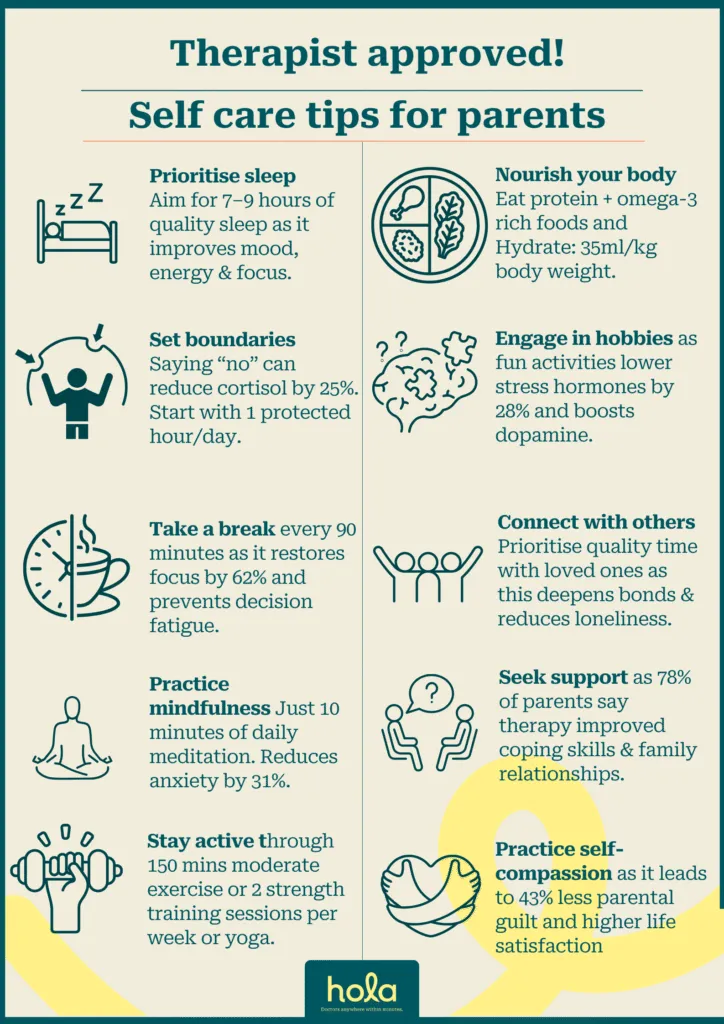
Self-care is vital for sustaining mental, emotional, and physical health. Incorporating small, consistent self-care practices can alleviate stress, boost resilience, and improve overall quality of life:
- Prioritise sleep: Aim for 7 to 9 hours of quality sleep to enhance mood, energy levels, and concentration.
- Set boundaries: Neuroscience reveals that saying “no” lowers cortisol levels by 25%. Start with one protected hour daily.
- Practice mindfulness: Activities such as meditation – just 10 minutes daily helps to reduce anxiety symptoms by 31%, and focussingactivities that helps in emotional regulation could be beneficial.
- Stay active: Regular physical activity, like walking or yoga, benefits mental and physical wellness. WHO recommends 150 minutes moderate exercise/week and 2 strength sessions. Yoga specifically decreases parenting stress by 27% (Pediatrics, 2022).
- Nourish your body: Eat protein + omega 3 rich foods, limit caffeine before 2pm and hydrate 35ml/kg body weight daily.
- Engage in hobbies: Dedicate time to enjoyable activities that provide relaxation and happiness as it lowers stress hormones by 28%, increase dopamine production (frontiers in Psychology, 2023)
- Connect with others: Deepen relationships by spending quality time with friends and family.
- Seek professional support: Therapy or counselling has helped 78% of parents as they develop better coping skills and improved family relationships.
- Take micro breaks: Regularly step away from responsibilities to refresh and avoid burnout Even 5 minutes pauses every 90 minutes restore focuses 62% and it prevents decision fatigue
- Practice self-compassion: Those who do experience 43% less parental guilt and reports higher life satisfaction. Taking care of yourself is not an extravagance; it is essential. Focusing on self-care can result in improved mental clarity, emotional stability, and a healthier, happier life.
Common postnatal mental health conditions
Postnatal mental health conditions are common and may affect 10-20% new mothers after childbirth (not all mothers). Key conditions include:
- Postpartum Depression (PPD): Typically begins 2-12 weeks postpartum (not first year), Includes impaired bonding and it affects 1 in 7 mothers (WHO,2023).
- Post-Traumatic Stress Disorder (PTSD): Requires specific diagnostic criteria (not just anxiety). Affects 3-15% of births depending on trauma definition
- Baby blues: Affects 50 to 80 % and lasts up to 2 weeks
- Anxiety Disorders: Includes intrusive thoughts and OCD symptoms may emerge postpartum
- Eating disorders: Most common 3-6 months of postpartum.
Other mental health conditions experienced by mothers
Some women may experience more severe mental health conditions during pregnancy or after childbirth. A history of mental health issues or the presence of certain risk factors may elevate the chances of experiencing, relapsing, or worsening a mental health disorder. These risk factors may include major life stressors (loss of a loved one or domestic violence), repeated trauma, or social isolation (due to distance or cultural differences). This may lead to several severe mental health conditions, including:
- Major life stressors (loss of a loved one or domestic violence)
- Hormonal changes postpartum
- Sleep deprivation
- Social isolation
- Postpartum psychosis
- Medical emergency requiring immediate treatment
- Occurs in 1-2 per 1,000 births
- Biploar disorder: High risk of postpartum episode (25%-50% of cases)
- Schizophrenia: May worsen postpartum in 20-25% of cases
Other mental health conditions experienced by dads
Fatherhood presents specific challenges that can affect mental well-being. While postnatal depression in mothers is widely recognised, 10 % of fathers can also experience various mental health issues, including:
- Paternal postnatal depression (PPND): Mood fluctuations, sadness, irritability, and social withdrawal following a child’s birth. It peaks at 3-6 months postpartum and linked to 34% lower testosterone levels (biological factor)
- Anxiety disorders: Persistent worry about parenting, finances, or the well-being of the baby. It affects 8-16% of new fathers and often focuses on financial stress.
- Post-traumatic stress disorder (PTSD): Can arise from a traumatic birth experience or a difficult pregnancy. Occurs in 5% of fathers after traumatic birth.
- Adjustment disorder: Difficulty adapting to fatherhood, which can result in stress and emotional turmoil.
- Sleep deprivation-related stress: Chronic lack of sleep impairs mood, patience, and mental clarity.
- Work-life balance stress: Pressure to provide financially while also being a present parent.
- Substance use issues: Substance use increases by 25% postpartum.
Identifying and addressing these conditions promptly can assist fathers in seeking the support necessary for a healthier and more satisfying parenting experience.
Where to get support?
If you are experiencing mental health challenges, various resources can provide support:
- GP or doctor: Your initial contact for evaluation, advice, and referrals.
- Mental health helplines: Lifeline (13 11 14) and Beyond Blue (1300 22 4636) are available 24/7.
- Workplace support: Employee Assistance Programs (EAP) provide confidential counselling services But it typically provides 4.6 sessions.
- Support groups: Community or online groups connect you with others facing similar difficulties.
Seeking assistance is a sign of strength, don’t hesitate to reach out for the support you deserve. Remember, you can’t pour from an empty cup! Taking time for yourself isn’t selfish—it’s vital. By setting limits, staying active, and making space for things you enjoy, you’ll be replenished and ready to face parenting with energy. So, go ahead and allow yourself to focus on YOU! Hola Health clinicians are AHPRA-registered Doctors and medical practitioners in Australia. They will always recommend an in-person consultation, specialist referral, or emergency care if that is in your best interest.
Note: Telehealth is not suitable for all conditions. Hola Health does not replace your regular GP, specialist, or emergency services. If you are unsure whether telehealth is right for your situation, we recommend speaking with your usual healthcare provider. In emergencies, call 000.
See an AHPRA-registered doctor online, anytime
24/7 across Australia
Authors

Editorial staff
Medically reviewed by

Amira Shah
Master’s in Counselling Psychology, Psychotherapist & Counsellor
8+ Years of Experience
Amira Shah is a trauma-informed psychotherapist with over a decade of experience in supporting women through complex mental health challenges. She holds a Master’s in Counselling Psychology and has worked extensively at a women’s centre, offering therapy to survivors of physical abuse, sexual assault, PTSD, and human trafficking. Amy owns her practice, Empathetic Counselling & Psychotherapy (ECP), and is committed to continuing her support for women.
Disclaimer
This blog is for general informational purposes only and does not indicate that Hola Health provides all treatments or preventive measures mentioned. It is not intended to be a substitute for professional medical advice. Always seek the guidance of your doctor or other qualified health professional with any questions you may have regarding your health or a medical condition. For emergencies please immediately contact 000. Any medical topics discussed are intended to educate, not to imply availability through Hola Health.
Note: At Hola Health, we're committed to offering trustworthy, accurate and up-to-date health information. Our Editorial Process entails thorough research, fact- checking, and medical review by doctors in diverse health fields, including medical practitioners, doctors, and psychotherapists based in Australia. We take guidance from qualified Australian doctors. We prioritise primary sources and avoid tertiary references wherever possible.
See a Aussie GP online, available 24/7
Download the app today.