

Contents
Antibiotics vs. antivirals: What’s the difference?

 ChatGpt
  Google AI Mode
  Perplexity
  Claude
 This blog is for educational purposes only and does not replace professional medical advice or diagnosis. If you have health concerns, consult an AHPRA-registered telehealth doctor or request a medical certificate online if clinically appropriate. Please note: Hola Health does not currently offer Mental Health Care Plans.
Have you ever wondered about the similarities and differences between antibiotics and antivirals? While both are essential tools in modern medicine, they target different types of pathogens and work in distinct ways. Let’s break down the key differences between antibiotics and antivirals, when they’re used, and why understanding this distinction matters for your health.
What is an antibiotic?
Antibiotics are powerful medications that fight bacterial infections. They either kill bacteria or prevent them from growing and reproducing, making them a cornerstone of modern medicine. Antibiotics have saved countless lives by effectively treating infections that would otherwise be life-threatening.
For example, penicillin—the first widely used antibiotic—revolutionised medicine by effectively treating infections like pneumonia, syphilis, and strep throat. Antibiotics work on specific structures or processes in bacteria—such as the cell wall or protein synthesis—that are not found in human cells. This makes them highly effective against bacteria while having minimal effects on our own tissues.
Illnesses treated by antibiotics
- Respiratory infections: Bacterial pneumonia, sinusitis, or bronchitis caused by bacteria such as Streptococcus pneumoniae.
- Urinary tract infections (UTIs): Commonly due to Escherichia coli.
- Skin infections: Examples include cellulitis or infected wounds.
- Strep throat: Caused by Streptococcus pyogenes.
However, antibiotics do not work against viruses, which is where antivirals come in.
What is an antiviral?
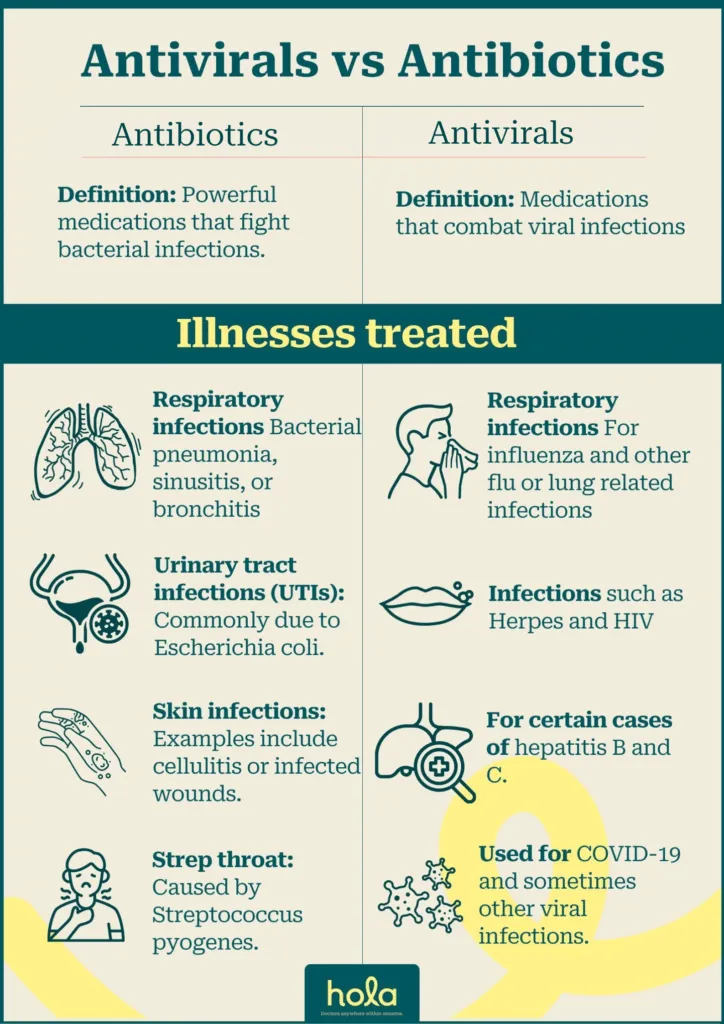
Antivirals are medications that combat viral infections. Because viruses are smaller than bacteria and rely on a host cell’s machinery to reproduce, treating viral infections is more complex. Antivirals typically work by:
- Inhibiting the virus’s ability to attach to or leave the host cell.
- Blocking the virus from replicating its genetic material within the host cell.
- Supporting the immune system’s ability to fight the infection.
Unlike antibiotics, many antivirals are virus-specific, meaning a medication effective against one virus may not work against another. Examples include:
- Oseltamivir (Tamiflu) or zanamivir: For influenza.
- Acyclovir or valacyclovir: For herpes infections.
- Antiretroviral therapy (ART): For HIV.
- Sofosbuvir or entecavir: For certain cases of hepatitis B and C.
- Remdesivir: Used for COVID-19 and sometimes other viral infections.
See an AHPRA-registered doctor online, anytime
24/7 across Australia
Antiviral illness management
Some antiviral treatments can effectively eliminate certain viruses from the body. For instance, specific antiviral regimens for hepatitis C can lead to a complete cure by clearing the virus. However, in many other cases (e.g., the flu, herpes), antivirals primarily reduce symptom duration or severity rather than fully eradicating the virus.
Why don’t doctors give antibiotics for viral infections?
A major misconception is that antibiotics can treat all infections. However, antibiotics only target bacteria. Viruses have different structures and rely on the host cell’s machinery to reproduce, so antibiotics can’t act on them.
Additionally, overusing or incorrectly using antibiotics contributes to antibiotic resistance—bacteria evolve to survive antibiotic treatment, making future infections harder to treat. This is why using the right medication at the right time is crucial.
When should you take antivirals?
Antivirals are generally recommended when:
- You have (or are suspected to have) a specific viral infection, such as influenza, herpes, or COVID-19.
- Your symptoms are severe or prolonged: Antivirals can reduce the duration of flu symptoms if taken within 48 hours of onset.
- You are at high risk of complications: For example, if you are pregnant, elderly, or immunocompromised, antivirals may be recommended to prevent serious illness.
Note that many mild viral infections (like the common cold) often resolve with rest, hydration, and supportive care—no antiviral is needed in those cases.
When should you take antibiotics?
Antibiotics are prescribed when:
- You have a confirmed bacterial infection: Lab tests or a clinical exam may indicate a bacterial cause, for example, a high fever with a sore throat confirmed as strep throat.
- You are likely to develop complications: For instance, a UTI that has spread to the kidneys.
- You are recovering from certain surgeries or injuries and are at high risk of bacterial infection.
Taking antibiotics without a doctor’s advice (or when they’re not needed) can lead to antibiotic resistance and disrupt your beneficial gut bacteria (the microbiome).
Secondary infections
Sometimes, a viral infection can weaken the body’s defenses and lead to a secondary bacterial infection (for instance, pneumonia following influenza). In such cases, both antivirals (to manage the underlying virus) and antibiotics (to address the bacterial component) may be appropriate. This should always be guided by a healthcare professional.
When to consider antivirals for the flu?
The flu is a common viral illness ranging from mild to severe. Antivirals like oseltamivir (Tamiflu) are most effective when taken within 48 hours of symptom onset. They won’t necessarily cure the flu but can:
- Shorten the duration of symptoms by about one to two days.
- Help prevent serious complications, such as pneumonia, especially in high-risk individuals.
If you suspect the flu, especially if you are at higher risk (e.g., pregnant, older adult, or immunocompromised), call your healthcare provider immediately to see if antivirals are appropriate.
How Hola Health may be able to help
Hola Health is an Australian telehealth platform that connects you with registered doctors and nurse practitioners — from the comfort of your home, at a time that suits you. Depending on your situation, a Hola Health clinician may be able to help with:
- 24/7 General medical advice via telehealth doctor consult – talk through symptoms or health concerns with a registered doctor or medical practitioner
- Online sick certificate – for work or personal leave, when clinically appropriate
- Referrals to specialists – or in-person services when needed
- 24/7 online instant scripts (if clinically appropriate) – at a clinician’s discretion and where clinically suitable
- Pathology or imaging requests – when assessed as appropriate by your treating clinician
Hola Health clinicians are AHPRA-registered Doctors and medical practitioners in Australia. They will always recommend an in-person consultation, specialist referral, or emergency care if that is in your best interest.
Note: Telehealth is not suitable for all conditions. Hola Health does not replace your regular GP, specialist, or emergency services. If you are unsure whether telehealth is right for your situation, we recommend speaking with your usual healthcare provider. In emergencies, call 000.
Conclusion
Both antibiotics and antivirals are designed to fight infections, but they target vastly different pathogens. Antibiotics are your best bet for bacterial infections, while antivirals address viral infections. Using the wrong medication can lead to resistance or unnecessary treatment, which is why these drugs should only be taken as advised by a healthcare provider. Knowing the difference helps you make informed decisions and protects the effectiveness of these life-saving medications.
The next time you’re ill, you’ll have a clearer understanding of whether you need an antibiotic, an antiviral, or simply rest and supportive care.
Authors

Medically reviewed by
Dr Nelson Lau
MBBS FRACGP, General Practitioner
30+ Years of Experience
Dr Nelson Lau is a highly experienced Doctors in Australia and digital health innovator with over 30 years of clinical practice. He is a graduate of the University of Western Australia and a Fellow of the Royal Australian College of General Practitioners (FRACGP).
Disclaimer
This blog is for general informational purposes only and does not indicate that Hola Health provides all treatments or preventive measures mentioned. It is not intended to be a substitute for professional medical advice. Always seek the guidance of your doctor or other qualified health professional with any questions you may have regarding your health or a medical condition. For emergencies please immediately contact 000. Any medical topics discussed are intended to educate, not to imply availability through Hola Health.
Note: At Hola Health, we're committed to offering trustworthy, accurate and up-to-date health information. Our Editorial Process entails thorough research, fact- checking, and medical review by doctors in diverse health fields, including medical practitioners, doctors, and psychotherapists based in Australia. We take guidance from qualified Australian doctors. We prioritise primary sources and avoid tertiary references wherever possible.
See a Aussie GP online, available 24/7
Download the app today.