

Contents
How to recognise and deal with an emotionally unavailable man

 ChatGpt
  Google AI Mode
  Perplexity
  Claude
 This blog is for educational purposes only and does not replace professional medical advice or diagnosis. If you have health concerns, consult an AHPRA-registered telehealth doctor or request a medical certificate online if clinically appropriate. Please note: Hola Health does not currently offer Mental Health Care Plans.
Emotional availability is key to a healthy relationship. An emotionally unavailable man avoids intimacy, struggles with vulnerability, and shows inconsistent affection. Recognising these behaviours early helps you set boundaries, protect your wellbeing, and decide whether to invest in the relationship or seek support for a healthier connection.
What it means if someone is emotionally unavailable?
An emotionally unavailable man often faces challenges in expressing, sharing, or connecting with his feelings within a relationship. He may avoid deep conversations, hesitate to commit, and struggle to form intimate bonds.
According to Beyond Blue, around one in eight men in Australia will experience depression, and one in five will experience an anxiety condition in their lifetime. Yet, many still find it hard to open up. This lack of emotional expressiveness creates a gap, leaving partners feeling neglected or isolated.
Where does it come from?
Emotional unavailability frequently stems from previous experiences or psychological patterns:
- Childhood trauma or neglect: Growing up without stable emotional support can hinder intimacy in adulthood.
- Past relationship pain: Experiences of betrayal or heartbreak may lead someone to withdraw as a self-protection mechanism emotionally.
- Fear of vulnerability: A hesitation to share feelings often arises from fears of rejection, criticism, or judgment.
- Attachment style: Individuals who exhibit an avoidant attachment style tend to create distance in their relationships.
- Mental health issues: Conditions like anxiety, depression, or PTSD can complicate emotional connections.
- Cultural and societal influences: In Australia, men are frequently conditioned to “toughen up,” making emotional vulnerability seem like a risk or a sign of weakness.
These factors create emotional distance, making it difficult for people to connect or share feelings in relationships.
How do emotionally unavailable men show love?
Emotionally unavailable men often face difficulties in expressing love in direct or vulnerable ways. Instead of openly sharing their feelings, they might express care through actions like completing tasks, gifting items, or spending time together without engaging in deeper conversations. These behaviours may convey concern, but they typically lack the regularity and openness that foster genuine emotional intimacy.
- A healthy expression of love is demonstrated through consistent support, transparent communication, and an openness to vulnerability. Partners should share their feelings, discuss challenges openly, and build trust through emotional closeness.
- Conversely, unavailable love often manifests as inconsistent affection, protective acts, or physical proximity while evading meaningful discussions. Such gestures might feel kind in the moment, but are erratic and seldom lead to a deeper connection.
Although both types of expressions might resemble love, only emotionally available love provides the stable foundation required for a robust and secure relationship.
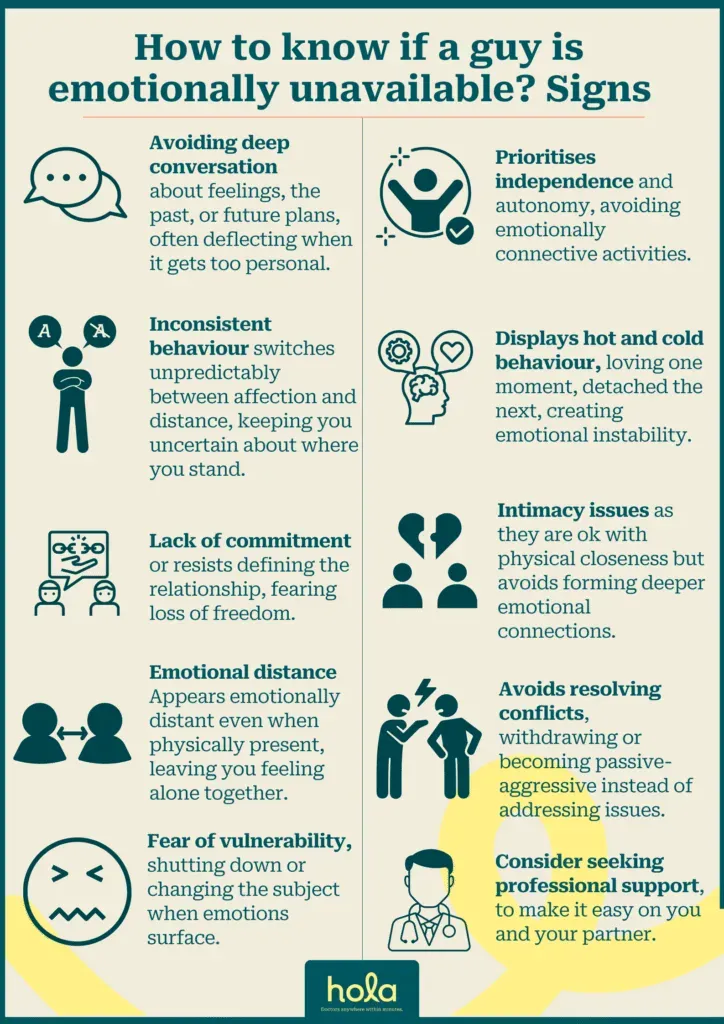
How to know if a guy is emotionally unavailable?
If you notice three or more of these signs, he may be emotionally unavailable:
- Avoids deep conversations – He avoids discussions about feelings, the future, or meaningful personal topics.
- Inconsistent behaviour – His affection and attention fluctuate unpredictably, leaving you unsure of where you stand.
- Reluctance to commit – He hesitates to define the relationship or make long-term plans.
- Emotional distance – Even when physically present, he remains detached and avoids vulnerability.
- Difficulty with conflict – He withdraws, shuts down, or uses passive-aggressive behaviour instead of resolving issues.
- Prioritises independence excessively – He values his personal space to the point of avoiding emotional connection or compromise.
Recognising these signs early can help you set boundaries, protect your emotional wellbeing, and decide whether to continue investing in the relationship.
Does no contact work on an emotionally unavailable man?
Providing an emotionally unavailable man with space can sometimes prompt reflection, but it doesn’t ensure change. He may come to realise he misses you, or he might withdraw even further emotionally. The most critical outcome is often for you: establishing boundaries, achieving clarity, and reclaiming self-worth. Even if he remains unchanged, you can heal and move forward with confidence.
Can emotionally unavailable people miss you?
Yes, they can miss you, but their manner of expressing it may be erratic. Rather than openly confessing their feelings, they might:
- send late-night messages
- emerge after periods of silence
- Or only reach out when feeling lonely
Missing you does not always indicate they are ready to be emotionally open, as genuine change requires a commitment to personal growth.
Could I be the emotionally unavailable one?
At times, you might come to the realisation that you, too, could be emotionally unavailable. Here are five signs to reflect on:
- You tend to avoid or shut down during profound discussions.
- You feel insecure when it comes to being vulnerable.
- You frequently select partners who are emotionally distant.
- You find it challenging to articulate your needs.
- You tend to withdraw as intimacy deepens.
Becoming conscious of these patterns isn’t a sign of weakness; it’s the first step toward cultivating healthier connections.
How to deal with an emotionally unavailable partner
Being in a relationship with someone emotionally unavailable can be perplexing and exhausting. Here are some approaches to help you manage and care for yourself:
- Recognise the indicators: Pay attention if he shies away from profound discussions, commitment, or establishing emotional connections.
- Express yourself clearly: Calmly articulate your needs and clarify how his actions impact you.
- Establish healthy limits: Decide which behaviours you will accept and which you won’t to safeguard your emotional wellbeing.
- Avoid trying to change him: Any emotional transformation must come from him, not you. You can provide support, but you cannot compel him to be vulnerable.
- Focus on yourself: Prioritise self-care, lean on your support network, and take care of your emotional health.
Seeking help for a relationship with an emotionally unavailable man
When your partner’s emotional distance leaves you feeling isolated or exhausted, consulting a professional can provide insight and guidance. Therapy can assist you in:
- Comprehending relationship dynamics
- Learning to establish and uphold boundaries
- Enhancing communication abilities
- Determining whether the relationship is healthy for you
When to stay vs when to walk away
Deciding whether to remain in a relationship with someone emotionally unavailable can be difficult. Utilise these guidelines to help you reach a clear conclusion:
When to stay:
- He recognises his emotional distance and is open to addressing it.
- There is an ongoing effort to communicate, seek therapy, or confront past issues.
- You feel respected, supported, and your boundaries are being honoured.
When to walk away:
- He declines to participate in emotional discussions or therapy.
- Your needs are regularly overlooked, dismissed, or belittled.
- Boundaries are consistently violated, leaving you feeling exhausted or unappreciated.
The relationship brings more stress than happiness, with no indication of improvement. Keep in mind, staying requires mutual commitment, while leaving should prioritise your wellbeing and emotional safety. Even if you decide to part ways, the experience can help you establish healthier expectations for future relationships.
See an AHPRA-registered doctor online, anytime
24/7 across Australia
FAQ
Yes. Cultural norms regarding masculinity often mean that many men find it difficult to be emotionally open.
Yes, Therapy can address underlying issues and foster healthier behaviours, though change requires the individual's commitment.
Introversion is about how one manages social energy and often includes a preference for being alone, whereas emotional unavailability involves a hesitance to connect deeply and be vulnerable in relationships.
Authors

Editorial staff
Medically reviewed by

Amira Shah
Master’s in Counselling Psychology, Psychotherapist & Counsellor
8+ Years of Experience
Amira Shah is a trauma-informed psychotherapist with over a decade of experience in supporting women through complex mental health challenges. She holds a Master’s in Counselling Psychology and has worked extensively at a women’s centre, offering therapy to survivors of physical abuse, sexual assault, PTSD, and human trafficking. Amy owns her practice, Empathetic Counselling & Psychotherapy (ECP), and is committed to continuing her support for women.
Disclaimer
This blog is for general informational purposes only and does not indicate that Hola Health provides all treatments or preventive measures mentioned. It is not intended to be a substitute for professional medical advice. Always seek the guidance of your doctor or other qualified health professional with any questions you may have regarding your health or a medical condition. For emergencies please immediately contact 000. Any medical topics discussed are intended to educate, not to imply availability through Hola Health.
Note: At Hola Health, we're committed to offering trustworthy, accurate and up-to-date health information. Our Editorial Process entails thorough research, fact- checking, and medical review by doctors in diverse health fields, including medical practitioners, doctors, and psychotherapists based in Australia. We take guidance from qualified Australian doctors. We prioritise primary sources and avoid tertiary references wherever possible.
See a Aussie GP online, available 24/7
Download the app today.