

Contents
Signs of an emotionally unavailable father: Therapist’s guide
 ChatGpt
  Google AI Mode
  Perplexity
  Claude
 This blog is for educational purposes only and does not replace professional medical advice or diagnosis. If you have health concerns, consult an AHPRA-registered telehealth doctor or request a medical certificate online if clinically appropriate. Please note: Hola Health does not currently offer Mental Health Care Plans.
In Australia, emotional distance from a parent often goes unnoticed — many dads show love through actions, not words. However, when emotional warmth is lacking, it can influence how children perceive connection and love. Growing up with an emotionally unavailable father can feel like trying to connect with someone who is always beyond your grasp, much like playing a game of emotional hide-and-seek.
More Aussies are turning to therapy to unpack how their upbringing affects adult relationships. Let’s explore the signs of emotional unavailability in fathers and how to overcome these emotional barriers.
Why emotional unavailability matters?
Emotional availability helps children feel safe, recognised, and supported. When a father is unable to provide that, the harm isn’t confined to childhood; it can echo into adulthood. You might struggle to trust, share your feelings, or feel like you’re a burden to others.
If you have ever felt overlooked by your father or sensed that his love was conditional, you’re not alone.
How does emotional unavailability show up?
Here are some signs your dad might have struggled with emotional connection:
Emotional distance
- Avoids emotional conversations
- Rarely shows affection
- Shuts down when you are upset
Behavioural signs
- Prioritise work over family and children
- Blames others instead of accepting responsibility
- Uses alcohol or substances to cope
Relational issues
- Kind to others but cold at home
- Struggles with stress or emotional closeness
- Avoids conflict, shuts down, or goes quiet.
This doesn’t mean your dad didn’t love you; he may have never been shown how to form emotional bonds.
What does an emotionally unavailable father look like?
For many Aussies, this might look like a dad who’s always working, cracks jokes to dodge real talk, or shuts down when emotions come up. You may have grown up constantly on guard or pushing aside intense emotions.
Emotional absence isn’t always intentional often, it reflects how they were raised.
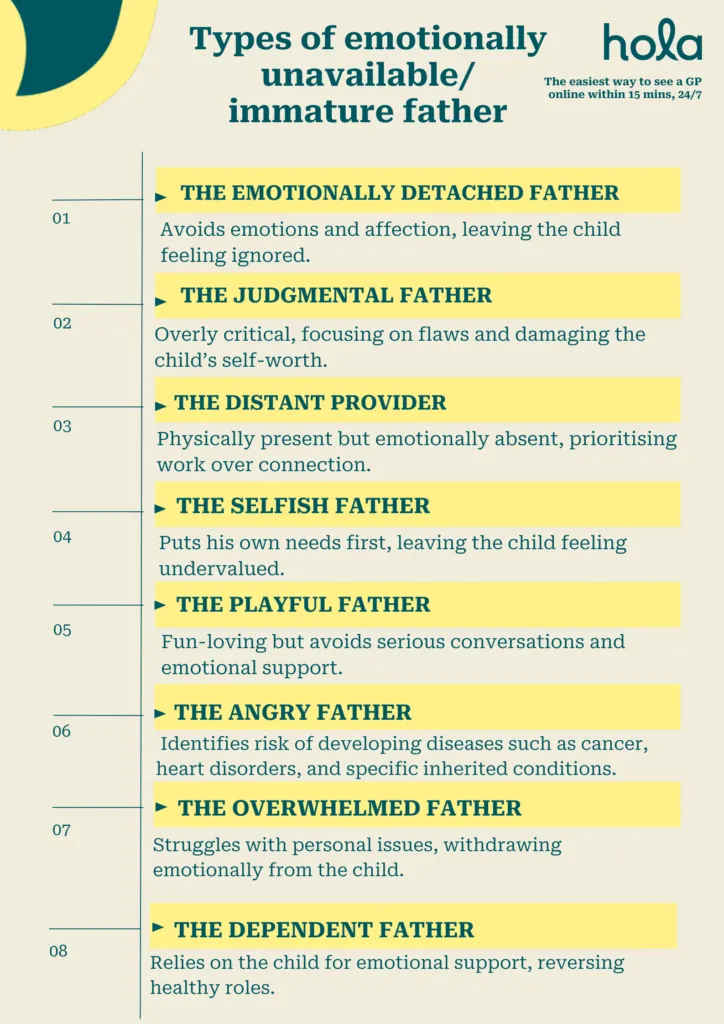
Types of emotionally unavailable fathers
Emotionally unavailable fathers can show up in different forms. Here are a few patterns therapists often see:
- The distant provider: Focused on work, provides financial support but is emotionally absent. Familiar in families where dads see their role as “earning, not feeling.”
- The avoidant father: Shuts down under pressure, physically present but mentally absent.
- The overwhelmed father: Struggles to manage his emotions due to personal issues like stress, trauma, or mental health problems. May withdraw or act unpredictably.
- The quiet Aussie man: Grew up thinking emotions are a sign of weakness. Bottles things up, often dismissing feelings with “be strong”.
Recognising your father’s type helps you understand the roots of your own emotional responses.
Symptoms of father trauma
Still feel uneasy in close relationships or struggle to trust? These might be signs of lingering father wounds
- Anger and resentment
- Low self-esteem
- Constant feelings of rejection
- Difficulty trusting others
- Avoidance of intimacy
- Struggles with forming stable relationships
- Perfectionism or fear of failure
- Difficulty with authority figures or men.
In Australia, more people are turning to therapy to understand how early emotional neglect shows up in adult life.
How does an emotionally absent father affect a daughter?
For many daughters, growing up without emotional support from their dad can lead to:
- Low self-esteem or confidence
- Attracting emotionally unavailable partners
- Fear of being rejected or not accepted
- Difficulty recognising and articulating feelings
If you recognise these signs, therapy can help break these cycles.
Therapist-backed tips for healing
Healing from emotional neglect takes time, but it is possible. Here’s where to begin:
Step 1: Acknowledge your feelings: It’s okay to feel angry, hurt, or confused. Your emotions are valid.
Step 2: Learn about attachment: Understanding your interactions with others can offer valuable insights into underlying patterns.
Step 3: Set emotional boundaries: Guard your energy; there’s no need to over-explain or “fix” him.
Step 4: Seek safe relationships: Build connections where your emotions are accepted, not dismissed.
Step 5: Start therapy: You can access therapy support under a Mental Health Treatment Plan (MHTP). Consult to online doctors or medical practitioner for a referral.
How to cope with an emotionally unavailable father
You can’t force emotional closeness, but you can protect your well-being and seek connection elsewhere.
- Accept that he may not change
- Focus on your own growth
- Find mentors who offer a healthy connection
- Keep emotional hopes in check
- Establish consistent self-care and safe emotional habits
Therapist tip: Set small emotional boundaries. You don’t need to fix your dad focus on what you can control.
Conclusion
An emotionally unavailable father can leave deep emotional scars, but identifying the signs is the first step toward recovery. With proper therapy and guidance, it is possible to break free from these patterns, develop stronger emotional ties, and regain your self-worth. Healing starts with awareness let’s make that happen!
See an AHPRA-registered doctor online, anytime
24/7 across Australia
Authors

Editorial staff
Medically reviewed by

Amira Shah
Master’s in Counselling Psychology, Psychotherapist & Counsellor
8+ Years of Experience
Amira Shah is a trauma-informed psychotherapist with over a decade of experience in supporting women through complex mental health challenges. She holds a Master’s in Counselling Psychology and has worked extensively at a women’s centre, offering therapy to survivors of physical abuse, sexual assault, PTSD, and human trafficking. Amy owns her practice, Empathetic Counselling & Psychotherapy (ECP), and is committed to continuing her support for women.
Disclaimer
This blog is for general informational purposes only and does not indicate that Hola Health provides all treatments or preventive measures mentioned. It is not intended to be a substitute for professional medical advice. Always seek the guidance of your doctor or other qualified health professional with any questions you may have regarding your health or a medical condition. For emergencies please immediately contact 000. Any medical topics discussed are intended to educate, not to imply availability through Hola Health.
Note: At Hola Health, we're committed to offering trustworthy, accurate and up-to-date health information. Our Editorial Process entails thorough research, fact- checking, and medical review by doctors in diverse health fields, including medical practitioners, doctors, and psychotherapists based in Australia. We take guidance from qualified Australian doctors. We prioritise primary sources and avoid tertiary references wherever possible.
See a Aussie GP online, available 24/7
Download the app today.