

Contents
What is quiet stress?

 ChatGpt
  Google AI Mode
  Perplexity
  Claude
 This blog is for educational purposes only and does not replace professional medical advice or diagnosis. If you have health concerns, consult an AHPRA-registered telehealth doctor or request a medical certificate online if clinically appropriate. Please note: Hola Health does not currently offer Mental Health Care Plans.
Overview
Quiet stress is a subtle yet significant form of stress that gradually accumulates, often unnoticed, until it begins to impact mental, emotional, and physical well-being. Unlike obvious stress, it manifests through persistent fatigue, headaches, irritability, emotional numbness, and difficulty concentrating. Common among high-achievers, it stems from bottled-up emotions, excessive workloads, and neglecting self-care.
To manage quiet stress, it’s crucial to acknowledge its presence, set boundaries, prioritise self-care, and seek support when needed. Mindfulness, relaxation techniques, and healthy habits can help alleviate its effects. If stress becomes overwhelming or prolonged, professional assistance, such as consulting an doctors or medical practitioner for a mental health problems can provide necessary support. By recognising and addressing quiet stress early, individuals can prevent long-term consequences and maintain overall well-being.
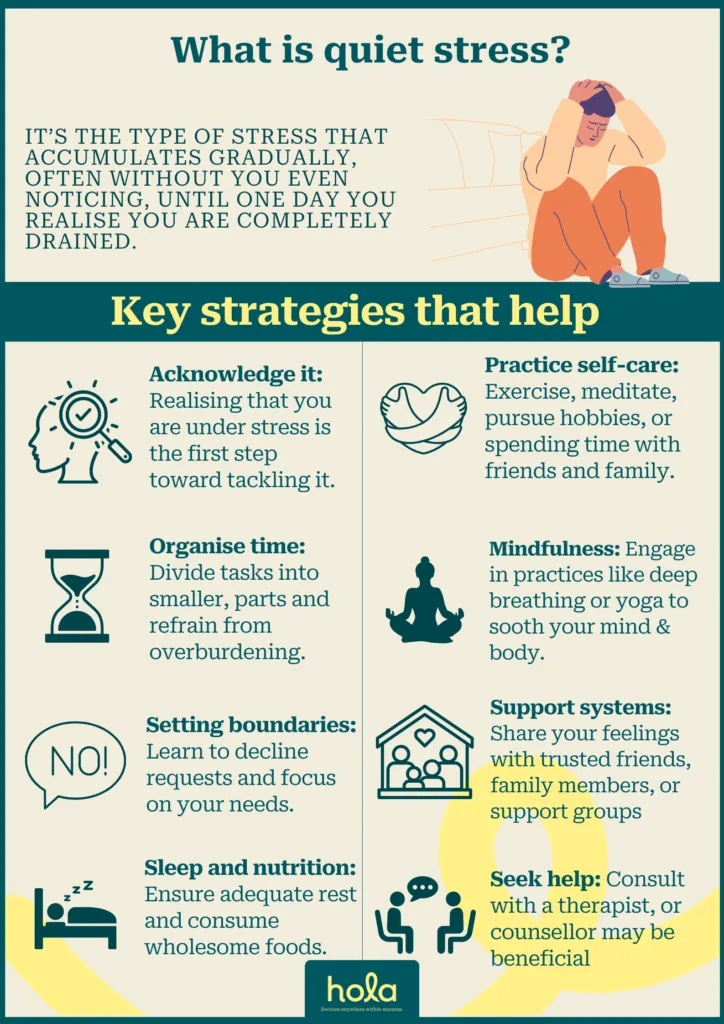
Stress is typically seen as a loud, obvious feeling—like a looming deadline or a heated argument. But there’s a quieter form of stress that silently takes its toll: quiet stress. It’s the type of stress that accumulates gradually, often without you even noticing, until one day you realise you are completely drained. Unlike the more dramatic, easily identifiable stress we usually notice, quiet stress is subtle, hiding beneath the surface and influencing your mental, emotional, and physical well-being in ways that are difficult to pinpoint. Let’s take a deeper look at this silent strain and how it can impact our lives.
What is quiet stress?
Quiet stress is a concealed type of tension that accumulates internally, often without overt signs such as panic or emotional breakdowns. It can show up as fatigue, headaches, irritability, emotional numbness, or difficulty focusing. Frequently impacting high-achieving individuals, it arises from bottled-up emotions, excessive workloads, perfectionism, or placing others’ needs above one’s own. It can also result in burnout, anxiety, or physical health problems. Identifying quiet stress early is crucial—engaging in mindfulness, establishing boundaries, prioritising self-care, and seeking assistance can be effective ways to manage it. Quiet stress may be subtle, but its consequences are significant, highlighting the importance of awareness and proactive stress management for overall well-being.
Realising you are suffering from quiet stress
Quiet stress is subtle yet significantly impactful, often overlooked until it starts to affect both mental and physical health. In contrast to obvious stress, it accumulates slowly, making it more challenging to identify.
Signs include:
- Persistent fatigue
- Trouble focusing
- Unexplained headaches or physical discomfort
- Irritability or emotional detachment
- Feeling overwhelmed without a clear reason
You might appear fine on the outside while struggling internally.
Why it happens:
Bottling up emotions, sidestepping conflicts, excessive work, or placing the needs of others before your own can contribute to quiet stress. This often targets high-achieving individuals who appear calm but are mentally drained.
What to do:
Recognise your emotions, engage in self-care, establish boundaries, and seek help. Techniques such as mindfulness, therapy, and stress management can aid in preventing long-term consequences.
How can quiet stress manifest itself?
Quiet stress can go unnoticed but still significantly impact your mental, emotional, and physical health:
Physical signs:
- Ongoing fatigue
- Headaches
- Muscle tension
- Digestive issues
- Unexplained body pain
Emotional effects:
- Irritability
- Mood swings
- Emotional numbness
- Feeling constantly overwhelmed
Cognitive symptoms:
- Trouble concentrating
- Forgetfulness
- Mental fog
- Difficulty making decisions
Behavioural changes:
- Withdrawing from social interactions
- Procrastination
- Increased reliance on caffeine or alcohol
- Disrupted sleep patterns
What should you do
If you’re dealing with quiet stress, here are some actions you can take to manage and lessen its effects:
- Acknowledge the stress: Realising that you are under stress is the first step toward tackling it. Be honest about your feelings and the impact they are having on your life.
- Set boundaries: Learn to decline requests and focus on your needs. Setting boundaries can help safeguard your energy and ward off burnout.
- Practise in self-care: Dedicate time to activities that are rejuvenating, whether that’s exercising, meditating, pursuing hobbies, or spending quality time with friends and family.
- Organise your time: Divide your tasks into smaller, achievable parts and refrain from overburdening yourself. Plan your day to incorporate regular breaks.
- Reach out for support: Share your feelings with a therapist, counsellor, or reliable friend. Sometimes, discussing your emotions can bring relief and offer a new perspective.
- Practice mindfulness and relaxation: Engage in mindfulness practices, deep breathing, or yoga to sooth your mind and body. These methods can aid in stress management and enhance emotional resilience.
- Prioritise sleep and nutrition: Ensure adequate rest and consume wholesome foods to sustain your energy levels and mood.
When and where to seek help
Individuals should consider seeking assistance when stress is prolonged, lasting for several weeks or months, and begins to interfere with daily life. Indicators such as persistent fatigue, heightened anxiety, increased irritability, or physical manifestations including headaches and muscle tension may warrant professional attention. It is advisable to pursue help if self-care measures prove ineffective, emotions become overwhelming, or if there is a tendency to engage in harmful coping strategies such as overeating or excessive consumption of alcohol.
Early intervention is crucial in mitigating long-term consequences and enhancing overall well-being. In instances where stress is unmanageable, obtaining professional support can be instrumental in achieving improvement.
In conclusion:
Quiet stress may sneak up on you, but with some mindfulness and small adjustments, it may not dominate your life. By recognising the signs, managing expectations, and prioritising self-care, you can keep this subtle stress under control. It’s about catching it early and giving yourself room to breathe. So, listen to your body, and don’t let quiet stress steal your peace!
See an AHPRA-registered doctor online, anytime
24/7 across Australia
Authors

Editorial staff
Medically reviewed by

Amira Shah
Master’s in Counselling Psychology, Psychotherapist & Counsellor
8+ Years of Experience
Amira Shah is a trauma-informed psychotherapist with over a decade of experience in supporting women through complex mental health challenges. She holds a Master’s in Counselling Psychology and has worked extensively at a women’s centre, offering therapy to survivors of physical abuse, sexual assault, PTSD, and human trafficking. Amy owns her practice, Empathetic Counselling & Psychotherapy (ECP), and is committed to continuing her support for women.
Disclaimer
This blog is for general informational purposes only and does not indicate that Hola Health provides all treatments or preventive measures mentioned. It is not intended to be a substitute for professional medical advice. Always seek the guidance of your doctor or other qualified health professional with any questions you may have regarding your health or a medical condition. For emergencies please immediately contact 000. Any medical topics discussed are intended to educate, not to imply availability through Hola Health.
Note: At Hola Health, we're committed to offering trustworthy, accurate and up-to-date health information. Our Editorial Process entails thorough research, fact- checking, and medical review by doctors in diverse health fields, including medical practitioners, doctors, and psychotherapists based in Australia. We take guidance from qualified Australian doctors. We prioritise primary sources and avoid tertiary references wherever possible.
See a Aussie GP online, available 24/7
Download the app today.