

Contents
Flu vaccine in children: When to call the GP

 ChatGpt
  Google AI Mode
  Perplexity
  Claude
 This blog is for educational purposes only and does not replace professional medical advice or diagnosis. If you have health concerns, consult an AHPRA-registered telehealth doctor or request a medical certificate online if clinically appropriate. Please note: Hola Health does not currently offer Mental Health Care Plans.
Summary: Flu season is here, and parents everywhere are asking if their kids need the flu shot. The short answer is yes, it helps prevent serious illness and protects the whole family. This guide covers everything from how the vaccine works, side effects to expect, and when to connect your online GP. With a little prep and clear info, the process can be simple and reassuring for both you and your child.
It’s that time of year again the sniffles are making their rounds at school, and every other parent at pickup is whispering something about the flu shot. If you’re a parent wondering whether your child really needs the flu vaccine, how it works, or when to ring up your GP, you’re in good company. Let’s walk through the key things you need to know—without the overwhelming jargon.
Does my child really need a flu vaccine?
Short answer? Yes. The Australian Technical Advisory Group on Immunisation (ATAGI) recommends the flu vaccine for most children over 6 months of age especially those with long-term health conditions.
Flu in kids can be more than just a few miserable days. It can lead to complications like pneumonia, ear infections, or, in rarer cases, hospital stays. Getting vaccinated reduces the risk of serious illness, keeps your child from spreading the virus to more vulnerable people (like grandparents), and makes your household just a bit more peaceful during flu season.
How is the flu vaccine given to children?
In Australia, the flu vaccine for children is given by a single intramuscular injection, typically in the upper arm. Children aged between 6 months and under 9 years receiving the vaccine for the first time require two doses, administered at least four weeks apart, while subsequent annual vaccinations require only one dose. All children aged from 6 months to less than 5 years, as well as older children with specific medical conditions, are eligible for free vaccination under the National Immunisation Program (NIP). Annual flu vaccination is generally recommended from April onwards, ahead of the peak flu season from June to September.
How long does the flu vaccine last?
The flu virus changes year to year, which is why the vaccine is updated annually. That also means your child needs a new flu shot every year. Protection generally kicks in about two weeks after getting the jab and lasts throughout flu season—usually until spring.
Get medical certificate sent via SMS, if approved
24/7 across Australia
My child is allergic to eggs. can they still get the flu vaccine?
This one’s a common worry. Some flu vaccines are grown in eggs, but that doesn’t necessarily rule them out. In most cases, children with egg allergies can still have the flu vaccine safely, even if their reaction was severe. However, it’s always best to speak with your GP or nurse first. They’ll guide you on the safest option based on your child’s allergy history.
Can my child get the flu vaccine alongside other routine jabs?
Yes—flu vaccines can be given at the same time as other childhood vaccinations. If your little one is due for another jab (like MMR or a COVID booster), there’s usually no need to spread them out. Still, if you have any concerns, it’s perfectly okay to ask your GP or health visitor to walk you through the timing.
Prepping for your child’s flu shot
There’s not a whole lot you need to do before the telehealth appointment, but a little prep can go a long way:
- Explain what to expect: Especially for young kids, knowing it’s just a quick injection with a little sting can ease anxiety.
- Dress comfortably: For those getting an injection, short sleeves help.
- Bring a distraction: A favourite toy, snack, or story can work wonders in the waiting room.
Post-shot care: What happens after?
Most children bounce back with barely a shrug, but here’s what’s normal:
- A runny or stuffy nose
- A low-grade fever
- Feeling a bit tired for a day or two
After the injection, you might also notice some soreness or redness at the site.
What should be avoided after a flu shot?
There’s no strict “do not do” list, but it’s sensible to:
- Skip intense physical activity for the rest of the day
- Keep an eye on symptoms
- Offer plenty of fluids and rest
Basically, just treat it like a low-key recovery day. Most kids don’t need anything special afterward.
Do flu shots give the child flu?
Nope. This myth has legs, but it’s just that—a myth. The injection contains an inactivated virus (aka: dead), which absolutely can’t infect you. If your child feels under the weather after the shot, it’s usually their immune system kicking into gear, not the flu itself.
How long after a flu jab can the child get side effects?
Most side effects, if they happen at all, pop up within a day or two. Occasionally, some kids may feel a bit off for 48 hours, but it usually passes without fuss. Serious side effects are extremely rare.
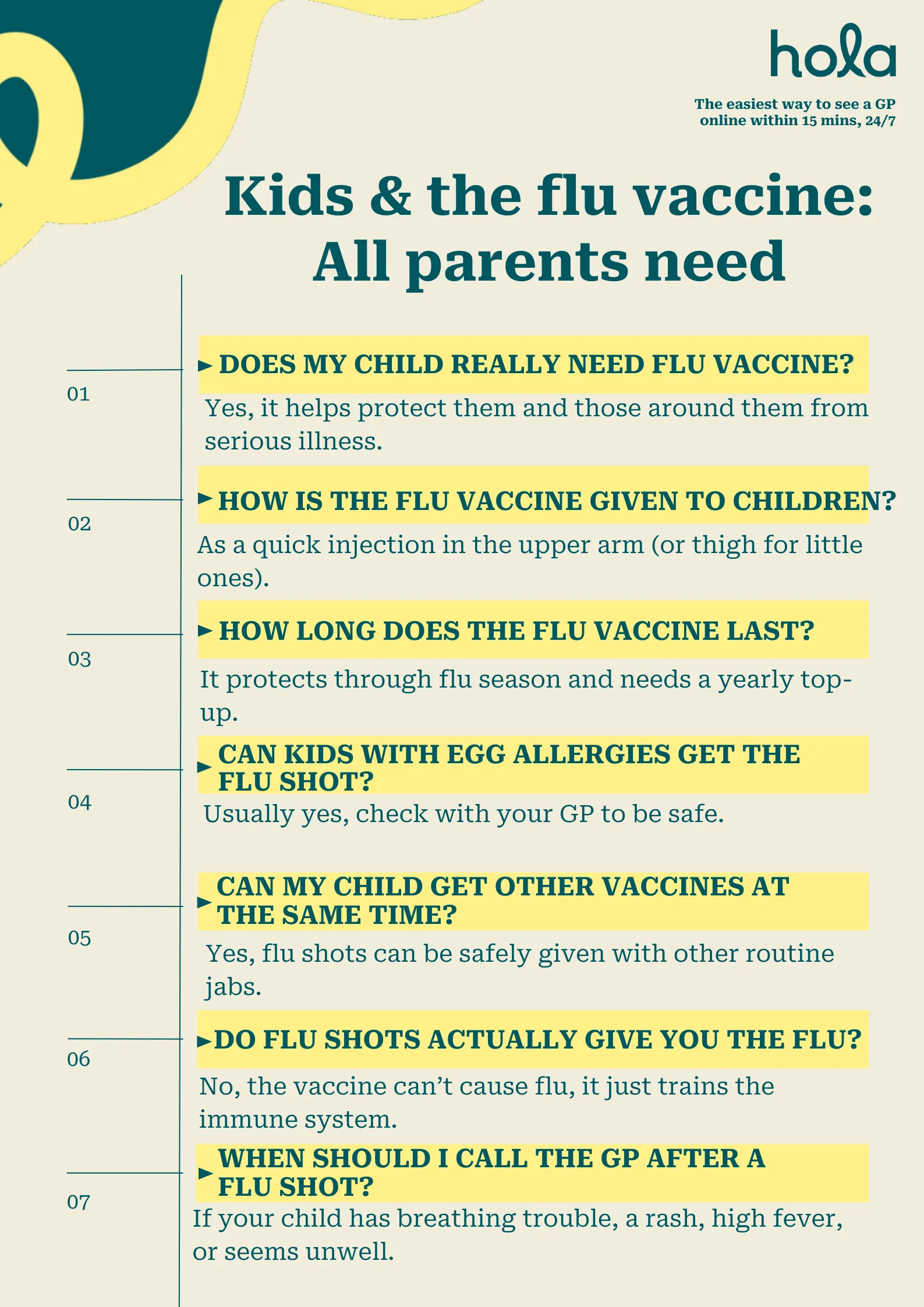
When to seek medical attention
This is where your parental radar really matters. Call your GP or seek help if:
- Your child develops difficulty breathing
- A rash spreads quickly or looks unusual
- They have a high fever that doesn’t come down
- They seem unusually drowsy, confused, or unresponsive
- You suspect a serious allergic reaction (swelling of the lips, face, difficulty breathing)
Trust your gut—if something doesn’t feel right, don’t hesitate to see your doctor.
When should I contact GP about flu shot?
There are a few moments when picking up the phone is a good idea:
- Your child has a chronic condition (like asthma, or heart problems) and you’re unsure about timing.
- You missed the school-based flu program and need to book it separately.
- You’re not sure if your child is eligible or if they’ve already had the jab this season.
- Your child is unwell on the day of their appointment and you’re unsure whether to go ahead.
GPs and nurses are used to these questions you won’t be bothering them.
Consult for online scripts anytime, receive via SMS
24/7 across Australia
How Hola Health may be able to help
Hola Health is an Australian telehealth platform that connects you with registered doctors and nurse practitioners — from the comfort of your home, at a time that suits you. Depending on your situation, a Hola Health clinician may be able to help with:
- 24/7 General medical advice via telehealth doctor consult – talk through symptoms or health concerns with a registered doctor or medical practitioner
- Medical certificate online – for work or personal leave, when clinically appropriate
- Referrals to specialists – or in-person services when needed
- Get Instant script online (if clinically appropriate) – at a clinician’s discretion and where clinically suitable
- Pathology or imaging requests – when assessed as appropriate by your treating clinician
Hola Health clinicians are AHPRA-registered Doctors and medical practitioners in Australia. They will always recommend an in-person consultation, specialist referral, or emergency care if that is in your best interest.
Note: Telehealth is not suitable for all conditions. Hola Health does not replace your regular GP, specialist, or emergency services. If you are unsure whether telehealth is right for your situation, we recommend speaking with your usual healthcare provider. In emergencies, call 000.
Authors

Medically reviewed by
Dr Nelson Lau
MBBS FRACGP, General Practitioner
30+ Years of Experience
Dr Nelson Lau is a highly experienced Doctors in Australia and digital health innovator with over 30 years of clinical practice. He is a graduate of the University of Western Australia and a Fellow of the Royal Australian College of General Practitioners (FRACGP).
Disclaimer
This blog is for general informational purposes only and does not indicate that Hola Health provides all treatments or preventive measures mentioned. It is not intended to be a substitute for professional medical advice. Always seek the guidance of your doctor or other qualified health professional with any questions you may have regarding your health or a medical condition. For emergencies please immediately contact 000. Any medical topics discussed are intended to educate, not to imply availability through Hola Health.
Note: At Hola Health, we're committed to offering trustworthy, accurate and up-to-date health information. Our Editorial Process entails thorough research, fact- checking, and medical review by doctors in diverse health fields, including medical practitioners, doctors, and psychotherapists based in Australia. We take guidance from qualified Australian doctors. We prioritise primary sources and avoid tertiary references wherever possible.
See a Aussie GP online, available 24/7
Download the app today.