

Contents
Telehealth Appointments - Bridging The Gap In Healthcare
 ChatGpt
  Google AI Mode
  Perplexity
  Claude
 This blog is for educational purposes only and does not replace professional medical advice or diagnosis. If you have health concerns, consult an AHPRA-registered telehealth doctor or request a medical certificate online if clinically appropriate. Please note: Hola Health does not currently offer Mental Health Care Plans.
Overview
Even doctors have healthcare needs. I’m a nurse practitioner, but I still need ad hoc referrals to doctors or medical practitioners, a virtual doctor’s appointment for my family, and the occasional medical certificate. I (and my colleagues) understand the challenges our patients face daily: the juggle of work and home life responsibilities, and the difficulty making time for healthcare.
Often, your preferred doctor’s practice does not have any open appointments that fit neatly into your work-life schedule, which means it’s another ‘thing’ we all have to massage into our already busy weeks.
Telehealth services, such as Hola Health, for whom I practice, provide the public with quality and affordable healthcare when a patient is not able to obtain an appointment with their usual healthcare provider, or it’s a one-off need that does not require oversight by your regular doctor. Healthcare platforms that provide telehealth exclusively are a convenient supplemental service to your preferred local doctor.
How is telehealth changing Australia?
Telehealth was rapidly implemented in Australia as a crucial response to the COVID-19 pandemic, ensuring the continuity of medical care while minimising the risk of virus transmission. This change in healthcare delivery made virtual consultations, remote monitoring, and follow-up care possible during the pandemic. This significantly reduced the need for in-person visits, adhering to the social distancing guidelines.
The success of telehealth during the pandemic safeguarded public health in adversity. It highlighted the potential for long-term integration into the Australian healthcare system, prompting ongoing support and policy adjustments to sustain its use post-pandemic.
According to the Australian Government’s health and aged care website, just over half of the Australian population used telehealth for doctors or medical practitioner services in 2022. Over 118.2 million telehealth services were delivered by 95,000+ healthcare practitioners between March 2020 and July 2022, showing the widespread adoption of telehealth services.
How does telehealth work?
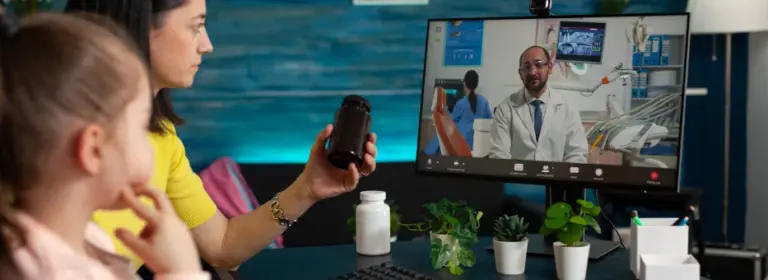
Telehealth delivers healthcare online using telecommunications technology. Patients can connect with registered Australian healthcare providers through video calls over the internet.
Online doctors have the same qualifications as in-person doctors and are registered with the Australian Health Practitioner Regulation Agency. Patients can identify a reputable telehealth provider, request a telehealth appointment, fill in their details, pay via a secure payment gateway, and speak to a telehealth doctor online.
What can be managed by telehealth and what are its limitations?
Telehealth can be an effective solution for the following medical issues:
- Minor illnesses (Colds, coughs, sore throat, fevers, digestion issues, headaches, etc)
- Minor injuries
- Management of chronic conditions such as asthma
- Seasonal allergies
- Addressing parental concerns
- Seeking medical advice in general
- People seeking prescriptions for normal medicines
- Online medical certificates for work/university/school
- Remote monitoring
- Post-operative care
- Skin issues such as acne
- Referrals for diagnostic tests or doctors or medical practitioners
Telehealth cannot be used for any medical condition that requires a physical check of the patient’s condition. Here are some scenarios where in-person doctor appointments might be better.
- Emergencies such as accidents
- Physical checks
- Conducting diagnostic tests such as blood tests, urine tests, advance imaging tests.
- Surgery
- Physical therapy
Why I Like Telehealth Appointments?
Australia ranks first among OECD countries for equity and healthcare outcomes and holds third place for overall healthcare performance (behind Norway and the Netherlands). Even so, healthcare is not often associated with convenience, and with the vastness of the Australian country and a cost-of-living crisis, there are still barriers to accessibility for many. Telehealth goes a long way to help with things.
Accessibility: Accessible healthcare means different things to different people.
1. Transport
Elderly patients, those with physical disabilities, young people, and those in regional areas will often face difficulties arranging transportation to a medical appointment. Costs association with transport are another barrier to accessing appropriate and timely healthcare. Telehealth appointments remove the worry and cost of finding transportation to and from a medical appointment.
2. Cost
Fewer and fewer doctors or medical practitioner practices are able to provide 100% bulk-billed consultations. As of 2023, the average gap fee for a doctor’s or medical practitioner consultation in Australia is $42.442. A traditional medical practice requires patients to book a standard consultation for a sick notes online, a referral, or a repeat prescription. Online telehealth services like Hola Health provide heavily reduced rates for services that don’t require the full length of an in-person consultation.
- Telehealth video consultations: Cheaper than the average gap fee, these 8-minute consultations are a cost-effective choice for multi-day medical certificates, multiple prescriptions, and doctors or medical practitioner and pathology referrals.
- Medical certificates: The Australian Medical Association’s guidelines for medical certificates3 advise that a medical certificate may be issued ‘based on a medical condition observed by the doctor or reported by the patient and accepted by the doctor.’ Because of this, a face-to-face appointment (and the associated cost) is often unnecessary. Hola Health, for example, provides telehealth medical certificates whereby a patient fills in an online form requesting a certificate and reporting their symptoms. An Australian Health Practitioner Regulation Agency (AHPRA) registered doctor or Nurse Practitioner reviews the written request (rather than an in-person one). This reduces time for the appointment, and thus the cost.
- Online Prescriptions: Similar to the telehealth medical certificate process, Hola Health telehealth prescriptions also use a form to minimise the face-to-face time required to discuss the details of the request, and in turn the cost to the patient. Use the form to request your medication, and a doctor or nurse practitioner will see you for a short telehealth video consult typically within 15 minutes (Based on typical wait times; may vary by demand and practitioner availability) of your request.
3. Availability
Telehealth providers often provide after-hours health consultation services. Hola Health, in particular, provides 24-hour, 7-day-a-week telehealth service.
Additionally, their service is provided “on demand,” which means that you’ll speak with a nurse practitioner or doctor, or have a medical certificate request reviewed, typically within 15 minutes (Based on typical wait times; may vary by demand and practitioner availability), any time of the day or night. Extended opening hours make healthcare far more accessible to those who also undertake their work or caring responsibilities within business hours.
4. Supply
7 million people (28% of the Australian population) live in rural and remote areas3 and often have less access to primary healthcare services and poorer health outcomes than people living in metropolitan areas. Telehealth is a game changer that unlocks Australia’s supply of doctors for regional and rural Australia.
5. Convenience
With the busy lives we all lead it can be difficult to find the time to fit in with the availability of your home doctor or medical practitioner. What’s more, often we need access to care after hours. Telehealth services that operate 24 hours a day, 7 days a week provide an option in those circumstances.
Being able to consult a doctor not just when you need it, but also taking the consult without having to leave the house, delivers a great level of convenience for patients.
See an AHPRA-registered doctor online, anytime
24/7 across Australia
What Are Telehealth Appointments Best Suited For?
Telehealth is useful in bridging with accessible healthcare. Online appointments allow patients to obtain medical care from the comfort of their own home. Telehealth appointments can also reduce the challenges that many patients have related to travel as many patients will often depend on public transportation to take them to and from the health care appointments.
1. Online Prescriptions
It’s common for patients to find themselves in need of a repeat prescription for their usual prescribed medication, and unable to get into their regular doctor to have it issued before running out. Abruptly stopping a medication can place a patient’s health and safety at risk resulting in adverse events, such as
- an exacerbation of asthma symptoms,
- increase in normally controlled blood pressure,
- or withdrawal symptoms.
Online telehealth services like Hola Health not only allow you to avoid the need to find time for an in-person appointment, but their service is “on demand,” which means you can make a prescription request via their online form, and a doctor (like me) or a nurse practitioner will review your request and have a video consultation with you typically within 15 minutes (Based on typical wait times; may vary by demand and practitioner availability), 24 hours a day.
2. Medical Certificates
As I mentioned earlier, single day medical certificates need not cost the same amount as a consultation when patients are self-reporting symptoms that make them unfit for work or study at university. This makes single day medical certificates ideal for telehealth.
3. Referrals
Telehealth can expedite the referral process because patients can receive consultations with a doctors or medical practitioner more quickly than waiting for a local primary healthcare appointment – especially for conditions that require a referral sooner rather than later.
4. Reassurance
We all have ‘those’ times when we’re pretty sure our symptoms (or our kids, partner’s etc) aren’t extreme enough to go to a hospital waiting room but we can’t get into a doctors or medical practitioner today and we’d really like to know we’re making the right choice.
Telehealth allows patients to seek reassurance from a doctors or medical practitioner from the comfort of their own home (24 hours a day with Hola Health). When a primary healthcare provider can advise us that we’re likely fine to rest up at home it can relieve anxiety, especially if the symptoms have outside of business hours.
How to choose the right telehealth platform?
Choosing the right telehealth provider is important to ensure you speak to registered Australian medical practitioners and can get valid and legitimate instant scripts or online medical certificates. Here are some guidelines for finding a genuine telehealth platform:
- The telehealth provider must have their physical address and support location mentioned on their site.
- Doctors in Australia registered with AHPRA must provide these services using a secure platform
- Look for a secure website address such as https://
- Read the reviews and testimonials by other patients to understand the service quality and speed
- Look for data-protection protocols of the telehealth service. They should also maintain strict patient-confidentiality
- They should have a secure payment gateway
- Online medical certificates or any medical documentation should have the doctor’s name and other details.
- Support information should be readily available if any technical difficulties arise.
Communication between patients and healthcare providers is a vital part of healthcare today. According to the National Institutes of Health (Vermeir et al., 2015), when providing healthcare, face-to-face communication between the patient and the healthcare provider is vital to get the full conversation.
By observing body language and facial expressions during the face-to-face encounter, this allows both parties to not only hear what is being said, but have a better understanding of what is being said. While telephone consultations have their place, telehealth appointments allow for this face-to-face communication with the patient online rather than in-person.
The “human factor” is a vital part of telehealth medicine and is crucial to providing patients with quality and affordable health care. During telehealth appointments, although the patient is not physically in the room with the patient, this online encounter provides a face-to-face encounter with the patient, always recognizing the “human factor” as a vital component to this interaction. As health care providers, our goal is to provide comfort to our patients, to make them feel better, to listen to the patient, and to provide feedback.
Although Telehealth is an important part of health care today, it was never intended to replace in-person appointments with a patient’s health care professional. Routine in-person health care appointments are important in helping a patient maintain their good health and well-being.
Request referral online. Get via SMS if approved
24/7 across Australia
Sources & references
Authors

Editorial staff
Medically reviewed by

Dr Vishnu Gopalan
MBBS, FRACGP
25 years in practice, Perth, WA
Dr Vishnu Gopalan is a highly experienced GP and Chief Medical Officer with over 25 years of clinical and healthcare leadership experience. He provides expert, evidence-based guidance in telehealth, with a strong focus on chronic disease management, preventive care, and digital health innovation.
Disclaimer
This blog is for general informational purposes only and does not indicate that Hola Health provides all treatments or preventive measures mentioned. It is not intended to be a substitute for professional medical advice. Always seek the guidance of your doctor or other qualified health professional with any questions you may have regarding your health or a medical condition. For emergencies please immediately contact 000. Any medical topics discussed are intended to educate, not to imply availability through Hola Health.
Note: At Hola Health, we're committed to offering trustworthy, accurate and up-to-date health information. Our Editorial Process entails thorough research, fact- checking, and medical review by doctors in diverse health fields, including medical practitioners, doctors, and psychotherapists based in Australia. We take guidance from qualified Australian doctors. We prioritise primary sources and avoid tertiary references wherever possible.
See a Aussie GP online, available 24/7
Download the app today.