

Contents
Does reflux cause diarrhoea?

 ChatGpt
  Google AI Mode
  Perplexity
  Claude
 This blog is for educational purposes only and does not replace professional medical advice or diagnosis. If you have health concerns, consult an AHPRA-registered telehealth doctor or request a medical certificate online if clinically appropriate. Please note: Hola Health does not currently offer Mental Health Care Plans.
Overview
Ever had reflux and diarrhoea at the same time and wondered if they’re linked? You’re not alone. It’s more common than many realise. While one doesn’t directly cause the other, they often occur together due to shared factors like spicy foods, medications, or gut issues like Irritable Bowel Syndrome (IBS). Let’s explore the connection between reflux and diarrhoea, potential symptoms to watch out for, and when to seek medical advice.
Dealing with severe digestive upset means you need to be near your own bathroom, not sitting at a desk or commuting. If your stomach is acting up today, stay home and request a online medical certificate while you recover.
Are reflux and diarrhoea linked?
Reflux and diarrhoea don’t directly cause each other, but they often occur together because of common causes. Spicy or greasy meals, alcohol, and stress can irritate both the stomach and intestines. Some acid-blocking medicines, like PPIs, may induce diarrhoea as a side effect1. Gut issues like IBS, coeliac disease, or infections can lead to symptoms at both ends. So, while one does not directly cause the other, they’re often connected through shared underlying factors.
Why do reflux and diarrhoea sometimes happen together?
Reflux and diarrhoea can feel like a double blow, but there’s usually an underlying cause. Here are some common culprits:
- Food triggers: Fatty, spicy meals, caffeine, a greasy takeaway meal, or alcohol may irritate the gut and cause both reflux and loose stools.
- Irritable Bowel Syndrome (IBS): A common gut condition that often worsens with stress, changes in eating habits, or hormonal shifts. IBS can cause diarrhoea, abdominal bloating, and sometimes reflux-like symptoms.
- Infections: A stomach infection can lead to diarrhoea and nausea, sometimes worsening reflux. Urgent digestive symptoms caused by such infections frequently strike overnight, making an after-hours doctor the best resource for immediate medical guidance and support.
- Medications: Some reflux medications, especially proton pump inhibitors (PPIs), can cause diarrhoea as a side effect.
- Inflammation: Conditions such as gastritis or celiac disease can affect the entire digestive system, causing problems at both the upper and lower ends.
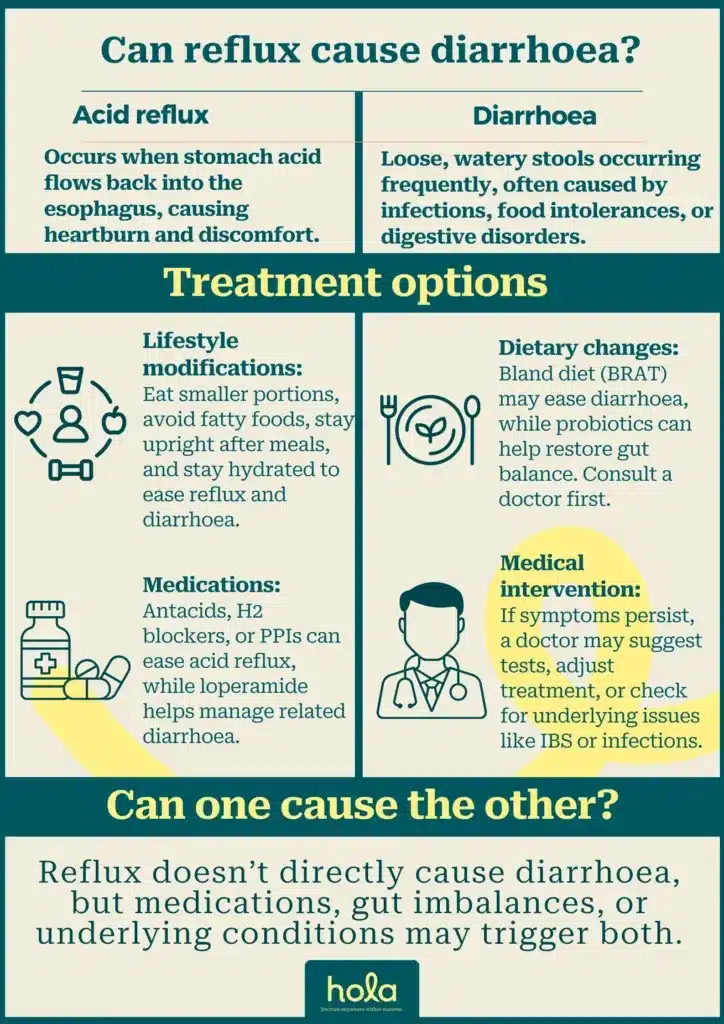
Quick takeaway- Reflux doesn’t cause diarrhoea directly, but certain foods, medications, or gut disorders can spark both.
Symptoms
It makes it easier to understand which symptoms stem from reflux, and which are connected to common digestive issues:
Reflux-related symptoms:
- Heartburn
- Sour or bitter taste in the mouth
- Difficulty swallowing
- Pain or discomfort after eating
Digestive symptoms that can overlap:
- Diarrhoea
- Constipation
- Bloating or gas
- Nausea
- Stomach cramps
Not all symptoms suggest something serious, but if they persist, it’s wise to seek medical advice.
See an AHPRA-registered doctor online, anytime
24/7 across Australia
Management options
Addressing reflux and diarrhoea often means looking at the whole picture—your diet, lifestyle, and any medications.
Lifestyle changes:
- Eat smaller meals more often
- Limit consumption of coffee, alcohol, and spicy meals
- Avoid lying down after eating
- Manage stress, as it has the potential to aggravate both reflux and IBS
Medications:
- Antacids (for quick relief)
- H2 blockers or PPIs (but PPIs may sometimes trigger diarrhoea, consult online GP or medical practitioner if you notice this)
Diet tweaks:
- Follow a bland diet (such as BRAT: banana, rice, apple sauce, toast)
- Maintain a food journal to track triggers
- Trial probiotics (but check with your GP or medical practitioner first)
Medical care:
- If symptoms persist, see your GP
- You may need a referral to a gastroenterologist or tests such as a stool sample or breath examination.
When to contact a GP?
Understanding when to seek help can prevent anxiety and multiple trips to the chemist.
See a GP if:
- You have frequent heartburn
- Diarrhoea lasts more than a few days
- Reflux or diarrhoea happens regularly
- There is unintentional weight loss
Call triple zero (000) or go to the emergency if:
- You notice blood in your stool or vomit
- Have acute chest pain or shortness of breath
- Have dehydration
Can a telehealth doctor help with reflux and diarrhoea?
If reflux and diarrhoea are persistent, severe or interfering with your daily activities, speaking with a doctor can help you understand your symptoms and whether further assessment is needed. A telehealth consultation can be a convenient way to discuss digestive symptoms from home when an online consultation is clinically appropriate.
During a telehealth consultation, a doctor can ask about your symptoms, when they started, your diet, medications and other relevant health information. If your symptoms require a physical examination, testing or further assessment, the doctor can advise you on the appropriate next step.
How Hola Health helps
With telehealth, you don’t need to leave home to manage reflux or diarrhoea. Through Hola Health, you can:
- Talk to a GP from home
- Get a prescriptions online sent directly to your local pharmacy
- Receive referrals to specialists if necessary
- Access same-day advice for persistent digestive issues
Need time off work? Hola Health can provide same-day online doctor certificate.
Conclusion
Reflux doesn’t directly cause diarrhoea, but the two often overlap due to shared triggers or treatments. If symptoms persist, talk to your GP. For convenient support, you can book a telehealth appointment with Hola Health and get treatment without leaving home.
Consult for online scripts anytime, receive via SMS
24/7 across Australia
- ✓ Diarrhoea is not a typical symptom of GERD. The main symptoms of GERD are heartburn and regurgitation, although other symptoms can occur.
- ✓ Diarrhoea can occur as a side effect of some reflux medicines. NIDDK notes that some antacids and proton pump inhibitors (PPIs) can cause diarrhoea in some people.
- ✓ Diarrhoea is common. Research cited by NIDDK suggests that people in the US experience acute diarrhoea about once a year on average, although the actual frequency may be higher because many people do not seek medical care.
- ✓ Up to 5% of people in the US may have chronic diarrhoea. NIDDK defines chronic diarrhoea as diarrhoea lasting at least four weeks.
- ✓ Three or more loose or watery stools a day is generally considered diarrhoea, or stools that are more frequent than is normal for you.
- ✓ Diarrhoea that lasts more than 2 days may warrant medical assessment in adults, particularly when accompanied by high fever, severe abdominal pain, repeated vomiting, blood or black stools, or signs of dehydration.
Sources & references
Gastro-oesophageal reflux disease (GORD) - Reference link NIDDK: Symptoms & Causes of GER and GERD – Use this to support the typical symptoms of reflux and explain why diarrhoea isn't a classic GERD symptom. NIDDK: Treatment for GER and GERD – Particularly useful for the medication/diarrhoea section. NIDDK: Symptoms & Causes of Diarrhea – Use for causes, warning signs and when diarrhoea needs medical assessment. NIDDK: Definition & Facts for Diarrhea – Best source for the 3+ stools/day, ~1× per year and up to 5% chronic diarrhoea statistics.Authors

Editorial staff
Medically reviewed by

Dr Nelson Lau
MBBS FRACGP, General Practitioner
30+ Years of Experience
Dr Nelson Lau is a highly experienced Doctors in Australia and digital health innovator with over 30 years of clinical practice. He is a graduate of the University of Western Australia and a Fellow of the Royal Australian College of General Practitioners (FRACGP).

Dr Ammar Al-Ani
General Practitioner - MBChB, CCBST, AMC
28+ Years of Experience
Dr Ammar Al-Ani is an experienced GP with over 28 years of clinical practice, including a strong background in surgery and primary care. He delivers evidence-based telehealth consultations, offering comprehensive and patient-focused care across a wide range of conditions.
Disclaimer
This blog is for general informational purposes only and does not indicate that Hola Health provides all treatments or preventive measures mentioned. It is not intended to be a substitute for professional medical advice. Always seek the guidance of your doctor or other qualified health professional with any questions you may have regarding your health or a medical condition. For emergencies please immediately contact 000. Any medical topics discussed are intended to educate, not to imply availability through Hola Health.
Note: At Hola Health, we're committed to offering trustworthy, accurate and up-to-date health information. Our Editorial Process entails thorough research, fact- checking, and medical review by doctors in diverse health fields, including medical practitioners, doctors, and psychotherapists based in Australia. We take guidance from qualified Australian doctors. We prioritise primary sources and avoid tertiary references wherever possible.
See a Aussie GP online, available 24/7
Download the app today.