

Contents
Can telehealth help with a cough?

 ChatGpt
  Google AI Mode
  Perplexity
  Claude
 This blog is for educational purposes only and does not replace professional medical advice or diagnosis. If you have health concerns, consult an AHPRA-registered telehealth doctor or request a medical certificate online if clinically appropriate. Please note: Hola Health does not currently offer Mental Health Care Plans.
Yes — telehealth is a convenient, effective option for managing a cough. Virtual doctors can assess symptoms, offer treatment plans, and prescribe medications without needing an in-person visit. It’s ideal for mild to moderate coughs but may recommend in-person care for severe or persistent symptoms. Quick, affordable, and accessible, telehealth helps you get expert advice from home when you need it most.
We’ve all been there. You wake up with a scratchy throat, maybe a tickle in your chest, and before long, you’re coughing uncontrollably. You ask yourself: Is this just a passing thing, or something more serious? Should I go to the doctor—or can I just handle this from home?
In today’s virtual world, telehealth has become a go-to option for managing minor (and sometimes not-so-minor) health issues. But does it work for something as common—and potentially complex—as a cough?
Short answer: Yes, but with some caveats. Let’s dig a little deeper.
Can I use telehealth for a cough?
Yes, you can—and many people do. In fact, a cough is one of the most common reasons people book a telehealth appointment. Whether your cough is dry or wet, lingering or sudden, a virtual visit can help you get clarity, relief, and maybe even a prescription—without ever stepping foot in a waiting room.
A virtual provider can:
- Review your symptoms
- Ask follow-up questions about duration, severity, and any triggers
- Watch for red flags (like breathing difficulty or high fever)
- Recommend over-the-counter meds or prescribe antibiotics if there’s a bacterial infection
- Suggest home care tips, like humidifiers, fluids, and rest
So yes—if your cough is making you uncomfortable, telehealth is a solid first step.
Also read: Most common reasons for sick days: Should you take sick leave?
At what point should I see or call a doctor for a cough?
While most coughs come from viruses like the common cold or flu and clear up on their own, some are warning signs that shouldn’t be ignored.
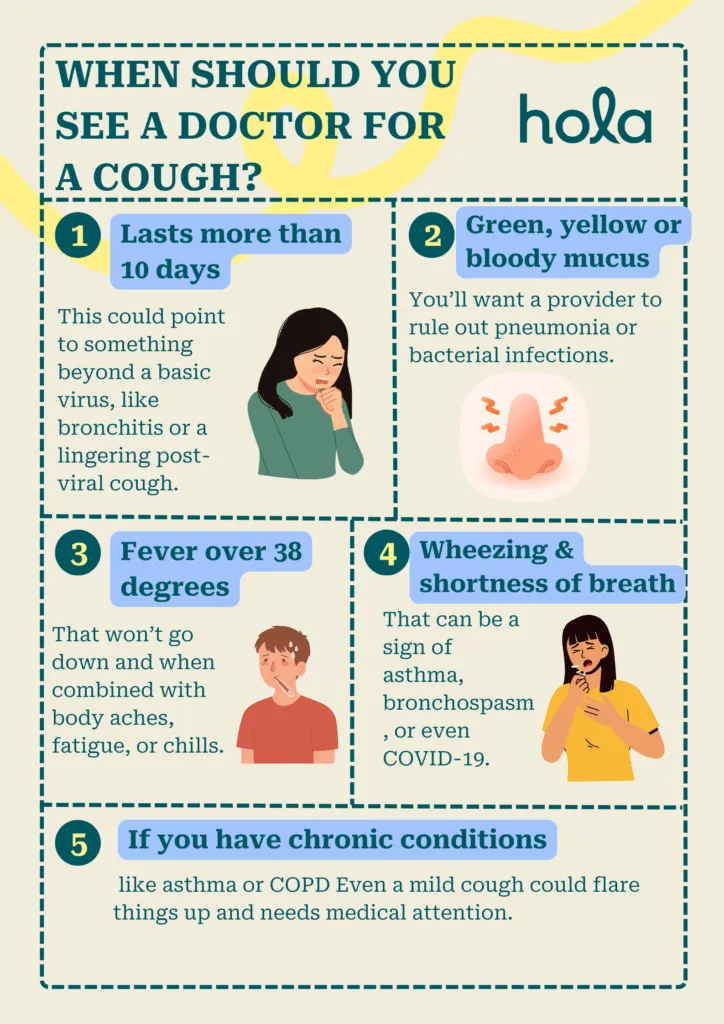
Here’s when to reach out to a doctor—virtual or otherwise:
- Your cough lasts more than 10 days This could point to something beyond a basic virus, like bronchitis or a lingering post-viral cough.
- You’re coughing up green, yellow, or bloody mucus That’s not normal. You’ll want a provider to rule out pneumonia or bacterial infections.
- You have a fever over 38°C that won’t go down Especially when combined with body aches, fatigue, or chills.
- You’re wheezing or short of breath That can be a sign of asthma, bronchospasm, or even COVID-19.
- You have a chronic condition like asthma or COPD Even a mild cough could flare things up and needs medical attention.
If any of this sound familiar, don’t tough it out—get in touch with a provider, even if it’s through a screen.
Can telehealth diagnose an upper respiratory tract infection?
Yes, and in many cases, quite effectively.
Upper respiratory tract infections (URTIs) include the common cold, sinus infections, laryngitis, and even mild cases of bronchitis. A telehealth provider will:
- Ask about your symptoms (cough, sore throat, nasal congestion, etc.)
- Listen to your cough if it’s audible
- Rule out more serious infections based on your description and risk factors
- Guide you toward next steps: treatment, rest, or (if needed) an in-person follow-up
However, telehealth isn’t magic. If a doctor suspects pneumonia or needs a chest X-ray or a physical exam, they may direct you to an urgent care center or your primary care office.
See an AHPRA-registered doctor online, anytime
24/7 across Australia
What happens during a telehealth visit for a cough?
Think of it as a video chat with your doctor—only a bit more structured.
Here’s a typical flow:
- Check-in and brief history: You’ll either fill out a short questionnaire or explain your symptoms live.
- Symptom deep-dive: The provider may ask how long you’ve been coughing, what makes it worse, if you’ve had a fever, etc.
- Visual cues: They might ask to see your throat, watch you breathe, or listen to your cough.
- Diagnosis and plan: Depending on your symptoms, they may provide a diagnosis, suggest treatments, or recommend in-person testing.
- Prescriptions or follow-ups: You might get an e-prescription or a request to follow up if symptoms worsen.
The whole thing usually takes 10–20 minutes, start to finish.
How to prepare for a telehealth visit for a cough
A little preparation beforehand can make the visit much smoother:
- Find a quiet, well-lit space Natural light or a lamp nearby can help the provider see your face and throat clearly.
- Have key info ready:
- When the cough started
- Whether it’s dry or productive
- Any medications you’ve tried
- If you’ve had a fever or chills
- Take your temperature and note your symptoms Bonus points if you have a pulse oximeter (to check oxygen levels) or know your resting heart rate.
- Bring a list of questions That way you don’t forget anything in the moment.
How does Hola Health help in managing your cough?
Hola Health makes managing a cough simple and stress-free. Through quick, online doctor consultations, you can connect with an registered doctors or medical practitioner in Australia from the comfort of your home. The doctor will assess your symptoms, ask about the type and duration of your cough, and recommend appropriate treatment, whether that’s over-the-counter advice, an online script, or further tests if needed. It’s a convenient, affordable option for busy people needing fast, professional care for coughs and other minor health concerns, without sitting in a waiting room.
Questions to ask a web doctor
Not sure what to say once you’re on the call? Start with these:
- “What’s the most likely cause of my cough?”
- “Could this be an upper respiratory tract infection or something else?”
- “Do I need antibiotics, or is this viral?”
- “When should I consider going to urgent care?”
- “How can I manage the symptoms at home?”
- “Could this be related to allergies, asthma, or acid reflux?”
Don’t be shy telehealth is still healthcare, and you deserve clear answers.
The upsides and downsides of treating a cough via telehealth
Benefits
- Convenience: No driving, no waiting rooms, no exposure to other germs
- Faster care: Many platforms offer same-day or even on-demand appointments
- Affordable: Often cheaper than urgent care visits
Challenges
- No physical exam: Some things just require a stethoscope or a chest X-ray
- Tech hiccups: Spotty internet or bad lighting can make it tough to assess you properly
- Follow-up needs: If symptoms worsen, you might still need to go in
Still, for many common coughs, the benefits far outweigh the trade-offs.
Telehealth isn’t a cure-all—but for a garden-variety cough, it’s often exactly what you need. You get expert advice, reassurance, and possibly treatment—all from the comfort of your home.
And if your cough turns out to be something more serious? That same provider can help you get where you need to go, fast.
So next time your throat’s scratchy and your chest is rattly, don’t wait it out in confusion. A few clicks could bring the care you need—no waiting room required.
Consult for online scripts anytime, receive via SMS
24/7 across Australia
Authors

Medically reviewed by
Dr Nelson Lau
MBBS FRACGP, General Practitioner
30+ Years of Experience
Dr Nelson Lau is a highly experienced Doctors in Australia and digital health innovator with over 30 years of clinical practice. He is a graduate of the University of Western Australia and a Fellow of the Royal Australian College of General Practitioners (FRACGP).
Disclaimer
This blog is for general informational purposes only and does not indicate that Hola Health provides all treatments or preventive measures mentioned. It is not intended to be a substitute for professional medical advice. Always seek the guidance of your doctor or other qualified health professional with any questions you may have regarding your health or a medical condition. For emergencies please immediately contact 000. Any medical topics discussed are intended to educate, not to imply availability through Hola Health.
Note: At Hola Health, we're committed to offering trustworthy, accurate and up-to-date health information. Our Editorial Process entails thorough research, fact- checking, and medical review by doctors in diverse health fields, including medical practitioners, doctors, and psychotherapists based in Australia. We take guidance from qualified Australian doctors. We prioritise primary sources and avoid tertiary references wherever possible.
See a Aussie GP online, available 24/7
Download the app today.