

Contents
Avian influenza (bird flu) in humans: What you should know

 ChatGpt
  Google AI Mode
  Perplexity
  Claude
 This blog is for educational purposes only and does not replace professional medical advice or diagnosis. If you have health concerns, consult an AHPRA-registered telehealth doctor or request a medical certificate online if clinically appropriate. Please note: Hola Health does not currently offer Mental Health Care Plans.
Summary: Avian influenza, primarily affecting birds, can occasionally affect humans through direct contact with infected poultry. Symptoms resemble those of the flu but can be more severe. Preventative measures include avoiding contact with sick birds, maintaining good hygiene, and cooking poultry thoroughly. Ongoing research and readiness are crucial to manage potential human outbreaks and avert a pandemic.
Avian influenza, known as bird flu, is a viral illness that primarily affects birds but can sometimes be transmitted to humans. This infectious disease has raised significant concerns due to its potential to cause widespread illness and even pandemics. Understanding its transmission, signs, hazards, and preventative measures is essential for safeguarding public health.
What is avian influenza?
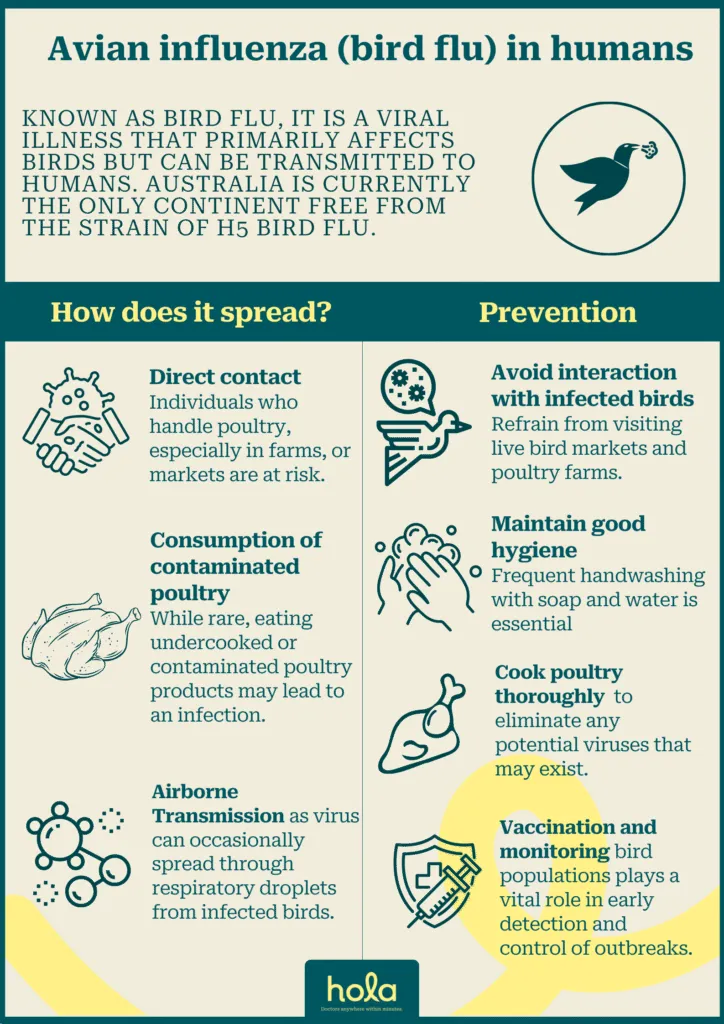
Avian influenza refers to a group of viral infections caused by various strains of influenza A viruses. These viruses mainly affect birds, particularly poultry. They are classified into different subtypes based on two proteins present on the surface of the virus: hemagglutinin (H) and neuraminidase (N). The most recognised and dangerous strain for humans is the H5N1 subtype. Although other strains, such as H7N9 have also led to human infections. Australia is currently the only continent free from the strain of H5 bird flu1.
While the majority of avian influenza cases affect birds, the virus can occasionally transfer to humans, usually through direct contact with infected poultry or contaminated environments. These cases are often severe, with a high fatality rate, and they raise concerns about the possibility of the virus evolving and becoming more easily spreadable between humans, potentially leading to a global pandemic.
What are the symptoms of avian influenza in humans?
The symptoms of avian influenza in humans are similar to those of seasonal flu and may include:
- Fever
- Cough
- Sore throat
- Fatigue
- Headache
- Muscle ache
- Runny nose
- Eye infections (conjunctivitis)
- Diarrhoea
- Shortness of breath
In severe cases, it may lead to pneumonia, neurological changes, organ failure, and death. The severity of symptoms differs depending on the strain of the virus.
See an AHPRA-registered doctor online, anytime
24/7 across Australia
How does avian influenza spread?
The main mode of transmission of avian influenza to humans is through direct contact with infected birds, their droppings, or contaminated surroundings. This may happen in several ways:
- Direct contact with infected birds: Individuals who handle poultry, especially in farms, or markets are at higher risk.
- Consumption of contaminated poultry: While rare, eating undercooked or contaminated poultry products may lead to an infection.
- Airborne transmission: The virus can occasionally spread through respiratory droplets from infected birds, but human-to-human transmission is rare.
The chances of human infection are higher in areas with widespread poultry farming, where surveillance and control measures may be inadequate. Some strains of avian flu, especially H5N1, are known to spread more rapidly among particular bird species, making those in close contact with infected birds, such as farmers and veterinary staff, more prone to infection.
Avian influenza mainly spreads to humans through close contact with infected birds, their droppings, or contaminated environments. The virus can also spread through contaminated food or air. The risk increases in regions with intensive poultry farming and inadequate control measures, and certain strains, like H5N1, make individuals handling infected birds more vulnerable.
Who is at risk?
People who are at risk of contracting avian influenza include:
- Poultry handlers: Those who work in farms, slaughterhouses, or live bird markets are more prone to get infected.
- People in direct contact with infected birds: Farmers, veterinarians, and individuals handling sick or dead birds are more at risk.
- Travellers to infected regions: Individuals visiting countries with avian influenza outbreaks are at a higher risk of getting infected.
- People with compromised immune systems: The elderly and individuals with long-term health conditions are more vulnerable to severe infections.
People at higher risk of avian influenza include poultry workers, those in direct contact with infected birds, travellers to affected regions, and individuals with weakened immune systems.
How can avian influenza be prevented?
Avian influenza, commonly known as bird flu, is a viral disease that mainly impacts birds but can occasionally infect humans. Implementing preventative measures is crucial for minimising the likelihood of transmission:
- Avoid interaction with infected birds: Refrain from visiting live bird markets and poultry farms. Avoid birds that display any signs of illness, particularly in areas experiencing outbreaks.
- Maintain good hygiene: Frequent handwashing with soap and water is essential, especially after coming into contact with animals or raw poultry. Keep unwashed hands away from your face.
- Cook poultry thoroughly: Make sure chicken, duck, and eggs are completely cooked to eliminate any potential viruses that may exist.
- Vaccination and monitoring: In areas at high risk, poultry may receive vaccinations. Monitoring bird populations plays a vital role in early detection and control of outbreaks.
By staying updated and adhering to proper hygiene and food safety practices, you can significantly decrease your chances of contracting avian influenza.
How is it diagnosed?
Avian influenza in humans can mimic other respiratory illnesses, making accurate diagnosis crucial for timely treatment and containment:
- Medical history and symptoms: A healthcare provider will start by inquiring about recent travel, exposure to birds, and symptoms such as fever, cough, sore throat, and difficulty breathing.
- Laboratory testing: To verify avian influenza, a sample from the throat or nose is taken and tested for the virus using techniques like RT-PCR (reverse transcription polymerase chain reaction), which identifies viral genetic material.
- Blood tests and imaging: Further investigations such as blood tests or chest X-rays might be utilised to assess the severity and exclude other conditions.
Timely and precise diagnosis helps in directing treatment and curbing the spread of avian influenza. Always reach out to a healthcare professional if you suspect exposure.
How is it managed ?
Immediate treatment of avian influenza can lessen the severity of the illness and avert complications, especially for high-risk individuals:
- Antiviral medications: Healthcare providers often recommend antiviral medications. These are most effective when administered within 48 hours of the onset of symptoms and can help decrease the duration of the illness.
- Supportive care: Patients may require rest, hydration, and medications to alleviate symptoms such as fever and pain. In severe situations, hospitalisation may be necessary for oxygen therapy or intensive care.
- Isolation and monitoring: To inhibit the transmission of the infection, patients may need to be isolated and closely monitored, particularly during outbreaks.
Early medical intervention enhances outcomes in cases of avian influenza. If you experience symptoms following bird exposure, seek prompt medical attention.
How Hola Health may be able to help
Hola Health is an Australian telehealth platform that connects you with registered doctors and nurse practitioners — from the comfort of your home, at a time that suits you. Depending on your situation, a Hola Health clinician may be able to help with:
- 24/7 General medical advice via telehealth doctor consult – talk through symptoms or health concerns with a registered doctor or medical practitioner
- Medical certificate online – for work or personal leave, when clinically appropriate
- Referrals to specialists – or in-person services when needed
- Get Instant script online (if clinically appropriate) – at a clinician’s discretion and where clinically suitable
- Pathology or imaging requests – when assessed as appropriate by your treating clinician
Hola Health clinicians are AHPRA-registered Doctors and medical practitioners in Australia. They will always recommend an in-person consultation, specialist referral, or emergency care if that is in your best interest.
Note: Telehealth is not suitable for all conditions. Hola Health does not replace your regular GP, specialist, or emergency services. If you are unsure whether telehealth is right for your situation, we recommend speaking with your usual healthcare provider. In emergencies, call 000.
Sources & references
- Avian influenza - reference link
- Influenza (avian and other zoonotic) - reference link
Authors

Editorial staff
Medically reviewed by

Dr Ammar Al-Ani
General Practitioner - MBChB, CCBST, AMC
28+ Years of Experience
Dr Ammar Al-Ani is an experienced GP with over 28 years of clinical practice, including a strong background in surgery and primary care. He delivers evidence-based telehealth consultations, offering comprehensive and patient-focused care across a wide range of conditions.
Disclaimer
This blog is for general informational purposes only and does not indicate that Hola Health provides all treatments or preventive measures mentioned. It is not intended to be a substitute for professional medical advice. Always seek the guidance of your doctor or other qualified health professional with any questions you may have regarding your health or a medical condition. For emergencies please immediately contact 000. Any medical topics discussed are intended to educate, not to imply availability through Hola Health.
Note: At Hola Health, we're committed to offering trustworthy, accurate and up-to-date health information. Our Editorial Process entails thorough research, fact- checking, and medical review by doctors in diverse health fields, including medical practitioners, doctors, and psychotherapists based in Australia. We take guidance from qualified Australian doctors. We prioritise primary sources and avoid tertiary references wherever possible.
See a Aussie GP online, available 24/7
Download the app today.