
Signs of an emotionally unavailable woman: Therapist’s guide
Contents
 ChatGpt
  Google AI Mode
  Perplexity
  Claude
 This blog is for educational purposes only and does not replace professional medical advice or diagnosis. If you have health concerns, consult an AHPRA-registered telehealth doctor or request a medical certificate online if clinically appropriate. Please note: Hola Health does not currently offer Mental Health Care Plans.
Overview
Some women keep their emotions guarded, making it hard to form deep connections. They may avoid commitment, shut down during conflict, or seem distant. This often comes from past trauma, rejection, or fear of intimacy. However, with the proper support, such as therapy or a Mental Health support in Australia, emotional connections can become stronger. Emotional availability means being able to share feelings, engage in meaningful conversations, be open and honest, and respond when someone needs closeness. When someone is emotionally unavailable, opening up feels overwhelming. If you’ve ever felt like you’re always reaching out, trying to connect, while she avoids, shuts down, or keeps her distance, If emotional distance is affecting your wellbeing, speaking with a doctor or health practitioner via telehealth can help you explore support options, including a Mental Health Treatment support in Australia. Let’s look at the signs and how therapy can help.
What is emotionally unavailable woman?
An emotionally unavailable woman struggles to connect deeply. She may avoid serious conversations, resist showing emotions, or seem distant. This behaviour often stems from previous trauma, feelings of rejection, or a fear of intimacy.
Why some women emotionally unavailable?
Here are some common causes:
- Childhood neglect: growing up without steady emotional care
- Abuse (physical, emotional, sexual): which can convince a person that opening up is a risk.
- Loss or betrayal: the pain of rejection, divorce, break-ups, often results in emotional numbness or shutting down.
- Cultural/family expectations: In some cultures, expressing feelings may be perceived as a sign of weakness.
- Toxic relationships: constant pain or control leads to broken trust.
- Stress and burnout: In Australia, work pressures, financial burdens, or natural disasters like bushfires could push individuals into “survival mode.” If this stress leads to acute anxiety or physical exhaustion late at night, speaking with an after-hours doctor or medical practitioner can provide immediate support and guidance.
Key signs
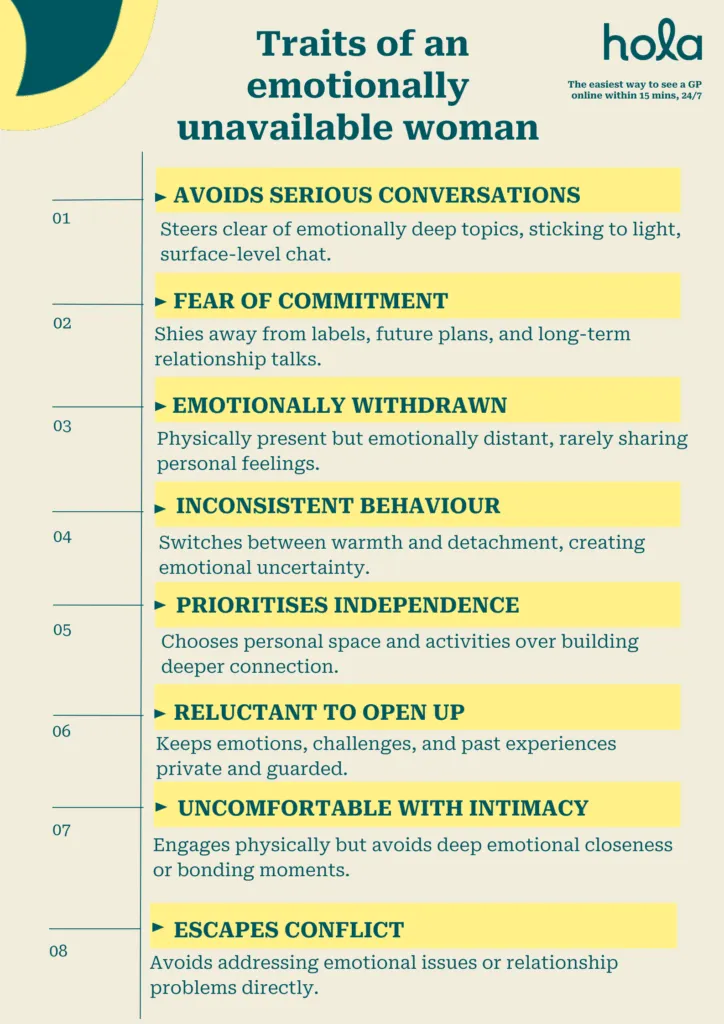
Unsure if she’s emotionally unavailable? Watch out for these behaviours:
- Avoids discussions about serious topics or plans.
- Seldom shares feelings or affection.
- Distances herself when intimacy increases.
- Demonstrates inconsistency or unreliability regarding commitment.
- Maintains emotional barriers even when desiring closeness.
- Shuts down during disagreements rather than addressing them.
- Appears more at ease with casual rather than long-term relationships.
If emotional stress is overwhelming and you need time to reset, you can request an online medical certificate through telehealth consultation. If clinically appropriate, certificates may be issued without needing to disclose personal details to your workplace or school.
Is emotional unavailability linked to trauma or mental health conditions?
- Trauma
- Anxiety
- Depression
- Attachment issues
- Emotional regulation difficulties
A doctor or health practitioner can assess symptoms and, if appropriate, provide a referral for counselling or create a Mental Health Treatment support under Medicare.
Emotionally unavailable vs guarded
The difference between emotional unavailability and being guarded stems from one’s capacity and willingness to connect emotionally. Here’s a brief comparison:
- Guarded: She is capable of connecting but requires more time to establish trust.
- Emotionally unavailable: She finds it challenging to feel or express emotions, often due to trauma or fear.
Let’s understand this better:
| Trait | Emotionally unavailable | Guarded |
| Openness to change | Often stuck due to past trauma or fear, may not even recognise the emotional block | More self-aware, cautious, but willing to build trust over time. |
| Responsiveness | Limited emotional response; may shut down | Responses may be slow or cautious, but possible |
| Vulnerability | Very uncomfortable showing a vulnerable side | Vulnerability is possible once safe and trust is built |
| Commitment | Resistance or fear of commitment. | More likely to commit after trust and emotional safety are established |
How to deal with an emotionally unavailable woman
Caring for someone emotionally unavailable can be exhausting. Instead of attempting to “fix” her, concentrate on providing healthy support:
- Identify the signs early so you understand the situation.
- Express your needs calmly and clearly.
- Honour her need for space while also establishing your own boundaries.
- Avoid taking on more responsibilities; you cannot do the emotional labour for her.
- Nurture your own wellbeing to prevent burnout.
Can emotional unavailability change with therapy?
Yes, change is possible, though progress may be slow. Therapy helps by:
- Identifying past wounds or trauma that create emotional barriers.
- Strengthening trust in relationships while embracing vulnerability and openness.
- Learning effective ways to express emotions and communicate constructively.
- Using treatments like a Mental Health Treatment support under Medicare in Australia, to access subsidised therapy sessions.
When to walk away vs when to stay
Each relationship is unique, but consider the following guidance:
- Stay if: She acknowledges the issue, is open to therapy, and behave with respect.
- Walk away if: She refuses to recognise the problem, dismisses your needs, or keeps you feeling constantly depleted.
Keep in mind, you also deserve a meaningful connection.
Here’s some additional guidance:
| Situation | Consider staying | Consider walking away |
| She shows willingness to work on things (therapy, open conversations). | Stay and support her growth. | If she refuses to try, denies there’s a problem, or blocks any progress. |
| The relationship gives you more positives than negatives (trust, connection, hope). | Stay and nurture the bond. | If you feel drained, lonely, or your wellbeing is worsening. |
| You can set boundaries and feel respected when you share your needs. | Stay — your voice matters. | If you’re constantly dismissed, disrespected, or made to feel unsafe. |
| The issues seem temporary (stress, grief, life upheaval). | Stay and give space for healing. | If patterns are long-term, unchanging, and causing ongoing harm. |
Ways emotionally unavailable women may still express love
Even if she has difficulty saying “I love you,” she might show her affection in subtle ways:
- Taking practical actions to assist you.
- Spending time with you, even if not very openly.
- Checking in indirectly when you’re feeling down.
Can emotional unavailability be a temporary state?
Yes. Stress, grief, or trauma can cause someone to be emotionally distant for a time. With proper time, support, and therapy, many individuals can become more emotionally open again. Note: Telehealth is not suitable for all conditions. Hola Health does not replace your regular GP, specialist, or emergency services. If you are unsure whether telehealth is right for your situation, we recommend speaking with your usual healthcare provider. In emergencies, call 000.
Conclusion
Emotional unavailability can feel like repeatedly hitting a wall, but it isn’t necessarily a lasting condition. With time, boundaries, and proper support, many women can become more open.
See an AHPRA-registered doctor online, anytime
24/7 across Australia
- ✓ Emotional unavailability is not a formal mental-health diagnosis. It is a descriptive term often used to describe patterns such as difficulty expressing emotions, avoiding vulnerability or struggling with emotional intimacy.
- ✓ Attachment avoidance can be associated with difficulties in close relationships and emotional regulation. Research suggests that people with higher levels of attachment avoidance may use different strategies to manage emotions in interpersonal relationships. This does not mean attachment style alone explains an individual's behaviour.
- ✓ Emotional difficulties can affect relationships and emotional connection. However, population-level mental-health statistics cannot be used to determine why a particular person may appear emotionally unavailable.
- ✓ People can experience loneliness or relationship difficulties for many different reasons. Feeling emotionally distant from a partner does not by itself indicate a mental-health condition or a particular attachment style.
- ✓ Emotional unavailability should not automatically be confused with emotional abuse. Someone may struggle with vulnerability, communication or intimacy without intentionally manipulating, controlling or harming their partner.
- ✓ Signs of emotional unavailability are not a diagnosis. Patterns such as avoiding vulnerable conversations, difficulty expressing feelings or withdrawing from emotional intimacy should be considered in the context of the person's circumstances and the relationship rather than used to label or diagnose them.
Sources & references
-
Australian Bureau of Statistics – National Study of Mental Health and Wellbeing
ABS: National Study of Mental Health and Wellbeing
Use this for the Australian mental-health statistics.
-
Australian Bureau of Statistics – Patient Experiences 2024–25
ABS: Patient Experiences 2024–25
Useful for current Australian data on people accessing mental-health professionals.
-
Australian Bureau of Statistics – Partner Emotional Abuse
Use this specifically when discussing the difference between emotional unavailability and emotional abuse.
Authors

Editorial staff
Medically reviewed by

Amira Shah
Master’s in Counselling Psychology, Psychotherapist & Counsellor
8+ Years of Experience
Amira Shah is a trauma-informed psychotherapist with over a decade of experience in supporting women through complex mental health challenges. She holds a Master’s in Counselling Psychology and has worked extensively at a women’s centre, offering therapy to survivors of physical abuse, sexual assault, PTSD, and human trafficking. Amy owns her practice, Empathetic Counselling & Psychotherapy (ECP), and is committed to continuing her support for women.
Disclaimer
This blog is for general informational purposes only and does not indicate that Hola Health provides all treatments or preventive measures mentioned. It is not intended to be a substitute for professional medical advice. Always seek the guidance of your doctor or other qualified health professional with any questions you may have regarding your health or a medical condition. For emergencies please immediately contact 000. Any medical topics discussed are intended to educate, not to imply availability through Hola Health.
Note: At Hola Health, we're committed to offering trustworthy, accurate and up-to-date health information. Our Editorial Process entails thorough research, fact- checking, and medical review by doctors in diverse health fields, including medical practitioners, doctors, and psychotherapists based in Australia. We take guidance from qualified Australian doctors. We prioritise primary sources and avoid tertiary references wherever possible.
See a Aussie GP online, available 24/7
Download the app today.