

Contents
UTIs and worsening dementia

 ChatGpt
  Google AI Mode
  Perplexity
  Claude
 This blog is for educational purposes only and does not replace professional medical advice or diagnosis. If you have health concerns, consult an AHPRA-registered telehealth doctor or request a medical certificate online if clinically appropriate. Please note: Hola Health does not currently offer Mental Health Care Plans.
Summary: Urinary tract infections (UTIs) can cause sudden confusion and behavioural changes in people with dementia, often worsening cognitive symptoms temporarily or, in some cases, accelerating decline. The elderly are more vulnerable to UTIs due to factors like weakened immunity, incontinence, and dehydration. Recognising signs such as increased confusion, agitation, or changes in urination is key for early intervention. Prevention includes good hygiene, hydration, and regular toileting. Hola Health’s online doctors offer fast, convenient care providing UTI diagnosis, prescriptions, medical certificates, and referrals, all from home, making it easier to manage UTIs in those with dementia.
Urinary tract infections (UTIs) are a common health concern, particularly among the elderly. However, for individuals with dementia, a UTI can be more than just a physical ailment, it can significantly impact cognitive function, sometimes leading to distressing behavioural changes. But can a UTI cause permanent worsening of dementia? How do these infections affect the elderly, and what can be done to prevent and manage them? This article explores the link between UTIs and dementia, the risks they pose, and the best ways to prevent and treat them.
Can a UTI make dementia worse permanently?
While a UTI can cause a sudden and severe decline in cognitive function, it is generally a temporary issue. Once the infection is treated, many individuals regain their previous level of mental function. However, in some cases particularly in advanced dementia an infection can act as a tipping point, accelerating the progression of cognitive decline. This is especially true if the UTI leads to complications such as sepsis or dehydration, which can cause long-term damage.
Is there a connection between UTI and dementia?
Yes, there is a well-documented link between UTIs and worsening symptoms of dementia. A UTI can trigger delirium, a state of acute confusion that can cause memory issues, hallucinations, agitation, and withdrawal. Because dementia already affects cognitive function, a UTI-induced delirium can exacerbate existing symptoms, making it difficult for caregivers and medical professionals to distinguish between infection-related confusion and disease progression.
Why are UTIs so bad for the elderly?
Older adults are more susceptible to UTIs due to a weakened immune system, reduced mobility, and conditions such as urinary retention or incontinence. In those with dementia, recognising and reporting symptoms is often challenging, leading to delayed diagnosis and treatment. Additionally, UTIs in the elderly can lead to severe complications, including kidney infections and sepsis, which can be life-threatening.
Symptoms of UTI in those with dementia
Recognising a UTI in someone with dementia can be difficult, as they may struggle to express discomfort or pain. Some common signs include:
- Increased confusion or sudden worsening of dementia symptoms
- Agitation or irritability
- Urinary incontinence or increased frequency of urination
- Foul-smelling or cloudy urine
- Fever or chills (though elderly individuals may not always develop a fever)
- Loss of appetite or dehydration
- Unexplained fatigue or lethargy
See an AHPRA-registered doctor online, anytime
24/7 across Australia
Causes and risk factors
Several factors increase the risk of UTIs in individuals with dementia, including:
- Reduced personal hygiene due to cognitive decline
- Urinary retention or incontinence
- Dehydration, which concentrates urine and encourages bacterial growth
- Use of catheters, which can introduce bacteria into the urinary tract
- A weakened immune system due to age or chronic conditions
- Chronic constipation and faecal soiling
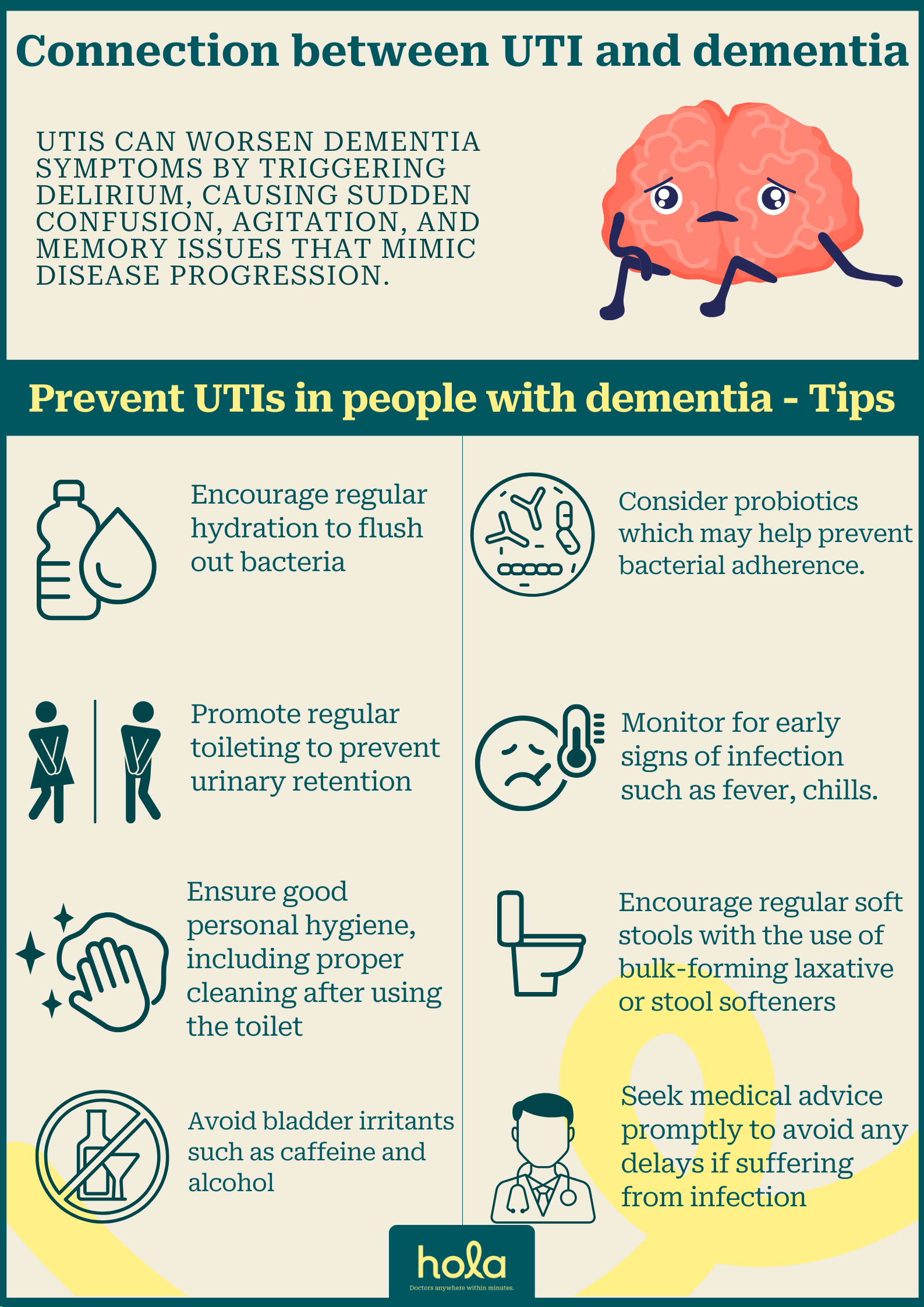
Tips to prevent UTIs in people with dementia
Preventing UTIs in those with dementia involves a combination of good hygiene, hydration, and medical management:
- Encourage regular hydration to flush out bacteria
- Promote regular toileting to prevent urinary retention
- Ensure good personal hygiene, including proper cleaning after using the toilet
- Avoid bladder irritants such as caffeine and alcohol
- Consider probiotics or cranberry supplements, which may help prevent bacterial adherence to the urinary tract
- Monitor for early signs of infection and seek medical advice promptly
- Encourage regular soft stools with the use of bulk-forming laxative or stool softeners.
Treatment for lower UTI
A lower UTI (bladder infection) is usually treated with oral antibiotics, increased fluid intake, and symptom management with pain relief if necessary. It’s essential to complete the full course of antibiotics to prevent recurrence.
Treatment for upper UTI
An untreated lower UTI can progress to an upper UTI (kidney infection), which requires more intensive treatment. In severe cases, hospitalisation may be necessary for intravenous antibiotics and fluids. Delayed treatment can lead to kidney damage or sepsis, making early intervention crucial.
Treatment for recurrent UTI
For individuals experiencing frequent UTIs, a long-term approach may be required. This could include:
- Low-dose preventive antibiotics
- Lifestyle modifications such as improved hydration and hygiene
- Addressing underlying conditions such as bladder dysfunction
- Oestrogen therapy for postmenopausal women, which can help restore the protective lining of the urinary tract
When to contact a doctors or medical practitioner?
A doctors or medical practitioner should be contacted if:
- Symptoms of a UTI appear, especially in someone with dementia
- There is a sudden decline in mental function or increased confusion
- Symptoms do not improve after starting antibiotics
- There are signs of a kidney infection, such as back pain, nausea, or fever
Get medical certificate sent via SMS, if approved
24/7 across Australia
How Hola Health may be able to help
Hola Health is an Australian telehealth platform that connects you with registered doctors and nurse practitioners – from the comfort of your home, at a time that suits you. Depending on your situation, a Hola Health clinician may be able to help with:
- 24/7 General medical advice via telehealth doctor consult – talk through symptoms or health concerns with a registered doctor or medical practitioner
- Doctors certificate online – for work or personal leave, when clinically appropriate
- Referrals to specialists – or in-person services when needed
- Instant scripts (if clinically appropriate)
- Pathology or imaging requests – when assessed as appropriate by your treating clinician
Hola Health clinicians are AHPRA-registered Doctors and medical practitioners in Australia. They will always recommend an in-person consultation, specialist referral, or emergency care if that is in your best interest.
Note: Telehealth is not suitable for all conditions. Hola Health does not replace your regular GP, specialist, or emergency services. If you are unsure whether telehealth is right for your situation, we recommend speaking with your usual healthcare provider. In emergencies, call 000.
Authors

Dr Gosagan Gopalakrishnan
BSc (Hons), MBChB, DRCOG, MRCGP, FRACGP
Medically reviewed by
Dr Gosagan Gopalakrishnan
BSc (Hons), MBChB, DRCOG, MRCGP, FRACGP
Dr Gos is a highly-skilled doctor with a profound commitment to combatting skin cancer. His expertise encompasses a comprehensive range of services, particularly excelling in intricate procedures like flaps and grafts, specifically tailored for delicate areas such as the nose, face, ears, scalp, and neck. He also performs cosmetic mole removal.
Disclaimer
This blog is for general informational purposes only and does not indicate that Hola Health provides all treatments or preventive measures mentioned. It is not intended to be a substitute for professional medical advice. Always seek the guidance of your doctor or other qualified health professional with any questions you may have regarding your health or a medical condition. For emergencies please immediately contact 000. Any medical topics discussed are intended to educate, not to imply availability through Hola Health.
Note: At Hola Health, we're committed to offering trustworthy, accurate and up-to-date health information. Our Editorial Process entails thorough research, fact- checking, and medical review by doctors in diverse health fields, including medical practitioners, doctors, and psychotherapists based in Australia. We take guidance from qualified Australian doctors. We prioritise primary sources and avoid tertiary references wherever possible.
See a Aussie GP online, available 24/7
Download the app today.