

How to get rid of cat allergies naturally?
Contents
 Facebook
  X
X  Copy Link
Summarise with AI:
 ChatGpt
  Google AI Mode
  Perplexity
  Claude
 Talk to an AHPRA GP for telehealth GP advice or med cert in minutes.
What causes cat allergy?
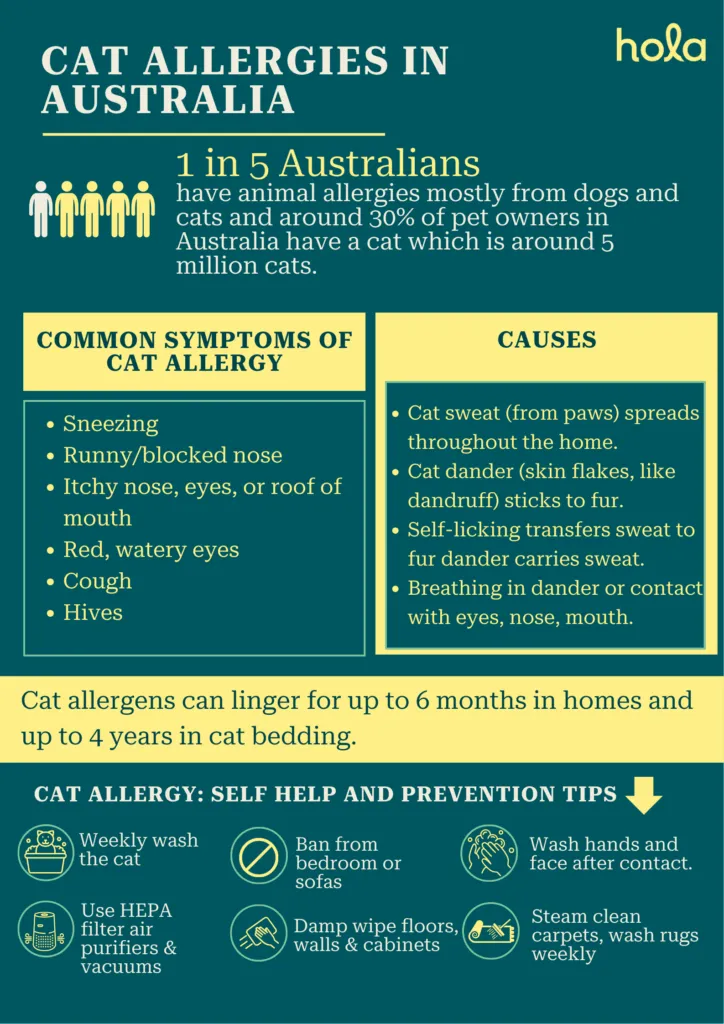
The sweat glands of cats are located in their paws, so cats can leave a trail of sweat as they move throughout the home. Animals will also shed skin cells (this is called “dander”, which is a similar concept to human “dandruff”) which can get stuck within the animal’s fur. As cats often lick themselves, their sweat can easily be transferred to their fur and therefore when dander sheds, sweat will often be attached to the dander. When a human breathes in cat dander, or if cat sweat comes into contact with the soft tissue lining your eyes, nose & mouth, it can trigger an allergic reaction in some people. For most, the allergy will be rhinitis-type symptoms (similar to “hay fever”, which is an allergy to pollen / grass). For many people, symptoms occur within 30 minutes of exposure but in up to 50% of allergy sufferers, symptoms can take as long as a few days to occur. Symptoms typically include some of;- sneezing,
- runny and/or blocked nose,
- itchy nose, eyes and roof of your mouth,
- red and watery eyes,
- cough
When should you consider medical help for cat allergies?
If allergy is suspected, and symptoms are troublesome enough to impact your activities of daily living or quality of life, then treatment is usually suggested. Discussing this with a doctor (such as a telehealth appointment with Hola Health) is recommended as treatment often involves rinsing out the nostrils and nasal cavity with a spray or squirt bottle containing saline (sterile salty water), followed by medication (both of which are sprayed into your nostrils) 60 minutes later. Nasal steroids and antihistamines are commonly suggested in combination, but in children it is less likely that nasal steroids would be suggested. Although nasal steroids are the most effective treatment, they can take up to a couple of days to start having benefit. Oral antihistamines are also a treatment option, although less effective than the nasal route. All medications can be purchased over the counter without the need for a prescription. Also read: When you should see an allergy specialistWhat are the best natural remedies for cat allergy?
The particles which make up the cat saliva can be so sticky that they can persist in the home for up to six months (even once the cat is removed), and in cat's bedding for up to four years. To help reduce this, treatment with medicines should not be used without simple self-help techniques, such as;- washing your cat weekly (in the interim, using pet friendly wipes can be a good way to give a quick clean of your pet),
- wearing a mask and gloves when washing your cat and when cleaning your home,
- keeping your cat away from your bedroom & carpeted areas of the house,
- keeping the cat off furniture,
- washing your hands, face & clothes after spending time with your cat,
- using an air purifier with a HEPA filter,
- washing your cat’s bedding and toys regularly with hot water,
- wiping down floorboards, walls and cabinets with a damp cloth regularly,
- using a household vacuum with a HEPA filter,
- regularly steam cleaning carpets, and washing rugs weekly with hot water.
Should I see a doctor if my allergies don’t improve?
In situations where there is ongoing need for medication, or the medication is not satisfactorily dealing with the symptoms, allergy testing is required to confirm the cause of the problem. A blood test can be arranged by the GP, but this is not as reliable as skin prick testing, which will require referral to an allergy specialist (immunologist). An immunologist can discuss the risks & benefits of desensitisation therapy which requires regular medication (often injections) for a total of 3 years. This is the only treatment that can modify disease progression with the possibility of long-term remission of the allergy.

See a Aussie GP online, available 24/7
Download the app today.


Related Articles

How Asthma Action Plans Help You Breathe Easier
What is an Asthma Action Plan and how does it help? Written by Dr Nelson...
Know All About The Summer Skin Rashes
Know All About The Summer Skin Rashes Written by Sai Pragna Chagarla, Staff Writer ÔÇô...
Disclaimer
This blog is for general informational purposes only and does not indicate that Hola Health provides all treatments or preventive measures mentioned. It is not intended to be a substitute for professional medical advice. Always seek the guidance of your doctor or other qualified health professional with any questions you may have regarding your health or a medical condition. For emergencies please immediately contact 000. Any medical topics discussed are intended to educate, not to imply availability through Hola Health.