
Contents
Skin checks in Australia – why it should be a priority?

 ChatGpt
  Google AI Mode
  Perplexity
  Claude
 This blog is for educational purposes only and does not replace professional medical advice or diagnosis. If you have health concerns, consult an AHPRA-registered telehealth doctor or request a medical certificate online if clinically appropriate. Please note: Hola Health does not currently offer Mental Health Care Plans.
Overview
Australia is known for its stunning beaches, abundant sunshine, and outdoor living, but this also comes with a major hazard: skin cancer. Skin cancer rates in Australia are some of the highest worldwide, mainly due to the nation’s proximity to the ozone layer depletion and strong UV radiation. About two out of three Australians will be diagnosed with some form of skin cancer in their lifetime. Skin checks or routine inspections of the skin for abnormalities should therefore be a priority for all Australians, as early identification of skin cancer can save lives. Let’s uncover why skin checks are essential, the relevance of early detection, and the contribution they make in preventing skin cancer-related deaths in Australia.
Note: This content is for general informational purposes only and does not constitute medical advice, diagnosis, or treatment. A telehealth consultation cannot replace a full-body physical skin cancer check. Diagnosis of skin lesions via video or photo is limited. Suspicious lesions will require an in-person physical examination or biopsy by a specialist. Referrals and prescriptions are issued at the strict clinical discretion of the doctor. We recommend sharing your consult summaries with your regular GP and bulk billing is available for eligible patients during Medicare-defined periods; otherwise, private fees apply. Ensure your privacy is protected. All consultations are strictly confidential and conducted via secure, encrypted platforms to safeguard your personal health data.
UV levels in Australia
UV levels in Australia are among the highest worldwide due to its closeness to the equator and thinning ozone layer. The sun’s intensity is greatest in the summer, particularly between 10 a.m. and 4 p.m., with UV levels reaching “Extreme” (UV index 11+) in many areas. Even when it’s cloudy, harmful UV rays can lead to skin damage, increasing the risk of skin cancer. To safeguard against this, Australia promotes sun safety programs encouraging sunscreen use, protective clothing, and regular skin checks to ensure skin health.
See an AHPRA-registered doctor online, anytime
24/7 across Australia
Skin cancer in Australia
Skin cancer is a big issue in Australia because of the high levels of UV exposure. The main reasons for this include spending a lot of time in the sun without proper protection, using tanning beds, and sometimes genetic factors that increase risk. It’s important to have regular skin checks because early diagnosis improves outcomes. Given the high number of skin cancer cases in Australia each year, an annual skin check is important, particularly for people who are more at risk, such as those with lighter skin or a family history of skin cancer. Around two in three Australians will be diagnosed with skin cancer in their lifetime, with melanoma affecting about 1 in 30 people and causing over 1,000 deaths annually.
In Australia, the most common types of skin cancer are Basal Cell Carcinoma (BCC), Squamous Cell Carcinoma (SCC), and Malignant Melanoma. Knowing about these risks and being vigilant for skin changes, such as moles undergoing changes in shape, size and colour and spots that itch or bleed, is important. It’s wise to have regular skin checks with a healthcare provider, and people at higher risk should be especially vigilant.
How often should you have a skin check in Australia?
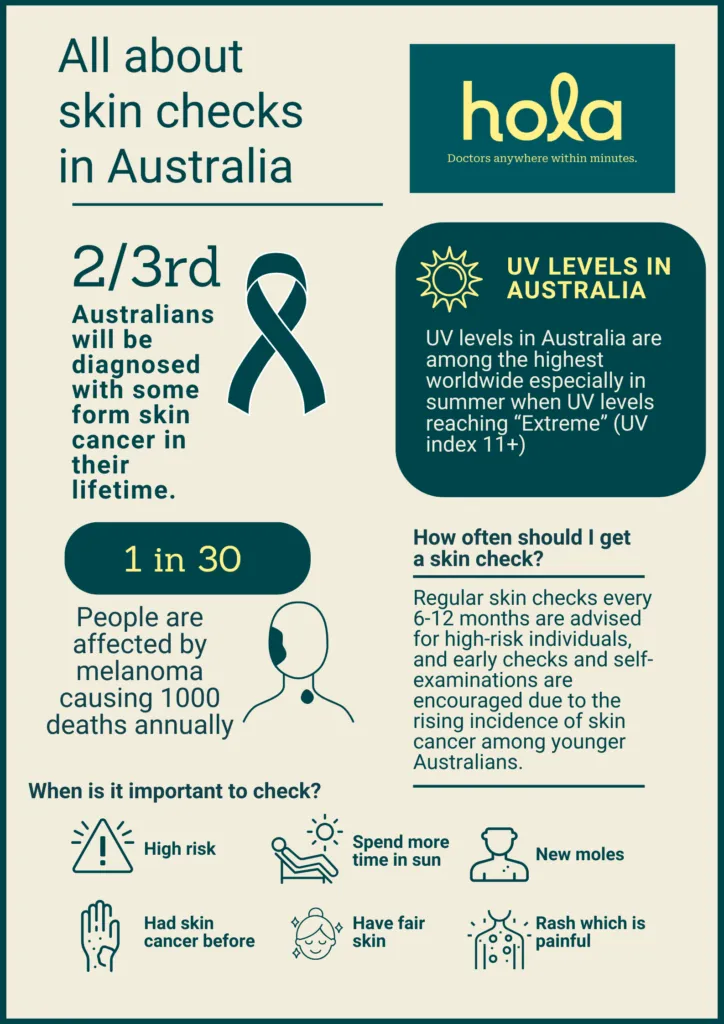
In Australia, how often you need a skin check varies based on individual risk factors. If you are high risk for skin cancer (a previous skin cancer diagnosis, history of significant sun exposure) it’s best to get checked every 6-12 months. It’s a good idea to start these checks early because skin cancer is becoming more common in younger Australians. Regular self-examination is also good practice.
When is it important to check?
If you’ve had skin cancer before, spent a lot of time in the sun, or have fair skin or lots of moles, keeping an eye on your skin health is important. Catching skin cancer early can lead to early treatment and a better prognosis so getting regular check-ups is important, especially for those at higher risk. Doing regular self-examinations between your professional physical visits is crucial. Follow the ABCDE rule of melanoma detection: look for spots with Asymmetry, irregular Borders, uneven Colours, a Diameter larger than a pencil eraser, or any spot that is Evolving (changing) over time.
How Telehealth Fits Into Your Skin Health Plan
While a comprehensive annual skin check must be performed in person — as a doctor needs to use a dermatoscope to examine your entire body — telehealth can be a useful tool for addressing specific skin concerns between your routine screenings.
How Hola Health connects you to care
Hola Health is an Australian telehealth platform that connects you with registered doctors and nurse practitioners from the comfort of your home, at a time that suits you. Depending on your situation, a Hola Health clinician may be able to help with:
- Spot checks: If you notice a changing mole or a new spot that bleeds, itches, or looks unusual, a telehealth GP may review high-quality photos and video to assess whether further investigation is needed.
- Fast referrals: If a lesion appears concerning, your clinician can provide an electronic referral to a dermatologist, skin cancer clinic, or other appropriate in-person service for further assessment, biopsy, or treatment.
- Pathology or imaging requests: Where clinically appropriate, doctors may provide referrals for blood tests or imaging to investigate related health concerns.
- 24/7 general medical advice: Discuss skin symptoms or other health concerns with an AHPRA-registered doctor or nurse practitioner via telehealth.
- Online prescriptions: Prescriptions may be provided at the clinician’s discretion and where clinically suitable.
- Medical certificates: Medical certificates for work or personal leave may be available when clinically appropriate.
Hola Health clinicians are AHPRA-registered doctors and nurse practitioners in Australia. They will always recommend an in-person consultation, specialist referral, or emergency care if that is in your best interest.
Important: Telehealth should never replace your routine, full-body skin cancer screening. It is not suitable for all conditions, and Hola Health does not replace your regular GP, specialist, or emergency services. If you are experiencing concerning symptoms or are unsure whether telehealth is right for your situation, speak with your usual healthcare provider. In an emergency, call 000 immediately.
Request referral online. Get via SMS if approved
24/7 across Australia
Authors

Editorial staff
Medically reviewed by

Dr Mark Mellor
General Practitioner - FRACGP, DCH, MBChB, BSc
15+ Years of Experience
Dr Mark Mellor is a highly experienced Specialist General Practitioner with over 15 years of clinical practice across the UK and Australia. At Hola Health, Dr Mellor provides online consultations for weight management, obesity-related health conditions, and general medical care.
Disclaimer
This blog is for general informational purposes only and does not indicate that Hola Health provides all treatments or preventive measures mentioned. It is not intended to be a substitute for professional medical advice. Always seek the guidance of your doctor or other qualified health professional with any questions you may have regarding your health or a medical condition. For emergencies please immediately contact 000. Any medical topics discussed are intended to educate, not to imply availability through Hola Health.
Note: At Hola Health, we're committed to offering trustworthy, accurate and up-to-date health information. Our Editorial Process entails thorough research, fact- checking, and medical review by doctors in diverse health fields, including medical practitioners, doctors, and psychotherapists based in Australia. We take guidance from qualified Australian doctors. We prioritise primary sources and avoid tertiary references wherever possible.
See a Aussie GP online, available 24/7
Download the app today.