

Contents
How to deal with negative thoughts: Trusted guide by therapists

 ChatGpt
  Google AI Mode
  Perplexity
  Claude
 This blog is for educational purposes only and does not replace professional medical advice or diagnosis. If you have health concerns, consult an AHPRA-registered telehealth doctor or request a medical certificate online if clinically appropriate. Please note: Hola Health does not currently offer Mental Health Care Plans.
Summary
Managing negative thoughts begins with self-awareness. Challenge irrational thoughts using Cognitive restructuring techniques (a core component of CBT). Utilise mindfulness to maintain presence and decrease overthinking. Shift negativity by practicing gratitude and evidence based positive reframing Engage in uplifting pursuits like aerobic exercise (proven to reduce rumination by 26%). If negative thoughts persist for more than two weeks and hinder daily activities, seek professional assistance. Negative thoughts aren’t they quick to appear out of nowhere? One minute, you’re on top of the world, and the next, you’re drowning in worries or doubts. What many people don’t realize is that the average person experiences about 6000 thoughts per day, with a significant portion being negative- this is normal brain functioning. Sounds familiar? Well, here’s the good news: You don’t have to let those negative thoughts control you. Therapists have some powerful tools to handle them and regain control. Ready to take charge of your mind? Let’s dive into some proven strategies to help you regain a sense of calm.
Examples of negative thoughts
Here are some common examples of negative thoughts that many people experience:
- “I’m not good enough.” – This represents “all or nothing thinking, a cognitive distortion where you ignore nuances and see things in extremes.
- “Everyone is judging me.” – known as “mind reading,”, where you assume you know others’ thoughts, without evidence.
- “I’ll never be able to do this.” – this shows “fortune telling,” where you predict negative future outcomes. “Nothing ever goes right for me.” – This is an example of “mental filtering,” where you focus on the negative.
- “What if something bad happens?” – This represents “catastrophising,” – common in anxiety disorders. A fear-driven thought where you envision the worst possible scenarios without any real reason.
- “I’m a failure” – A sweeping negative assertion that overshadows your achievements or success.
- “I’m always making mistakes.” – This thought magnifies errors, making you believe you’re powerless or incapable.
- “I’m too old/young to change.” – This reflects “fixed mindset thinking,” this thought restricts growth by solidifying the belief that change is impossible after a certain age.
Such negative thoughts often don’t reflect reality. Identifying them is the first step toward confronting and changing them.
How do I stop excessive negative thoughts?
Excessive negative thinking can be daunting, but implementing effective strategies can help you regain control of your mindset.
- Begin by recognising negative habits and pinpointing common triggers.
- Question negative thoughts by evaluating whether they are supported by evidence or assumptions.
- Employ mindfulness techniques such as deep breathing, meditation, or journaling to remain present and minimise overthinking.
- Shift your perspective by concentrating on solutions rather than problems.
- Participate in activities you enjoy, such as exercising, pursuing hobbies, or socialising, to divert attention from negativity.
- Reduce exposure to stressors like social media or toxic environments.
If negative thoughts continue to prevail and disrupt daily life, consider reaching out to a therapist or counsellor for support. Managing your thoughts requires practice, but taking small steps can lead to significant changes.
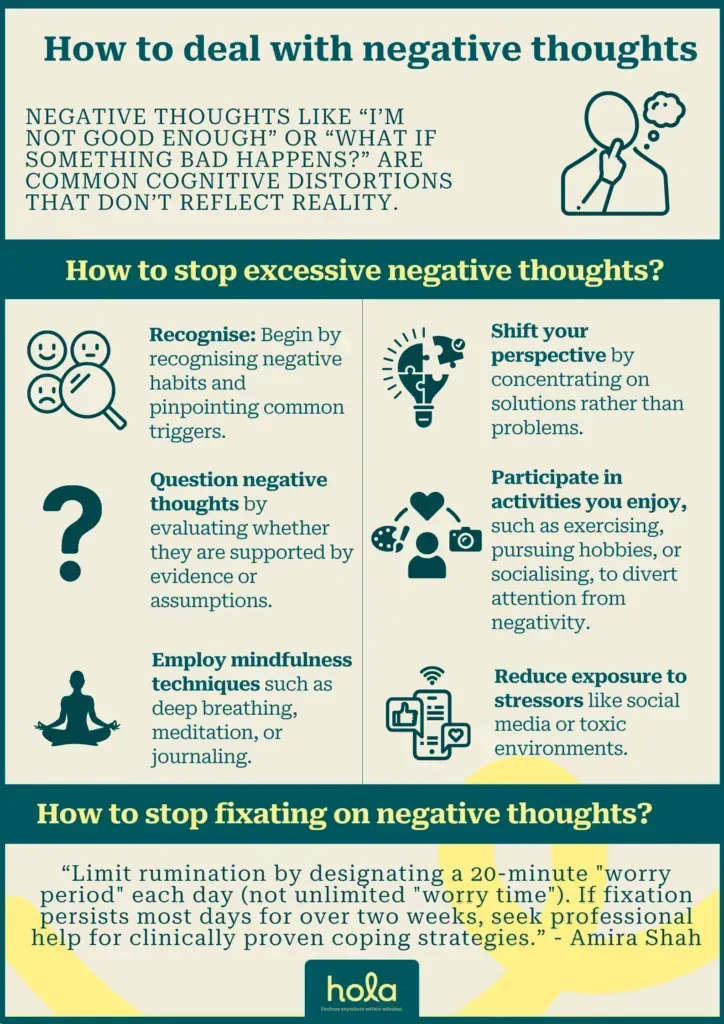
How to stop fixating on negative thoughts?
Amira commented – ‘To escape negative thought patterns, begin by acknowledging their occurrence. Assess irrational thoughts by using cognitive restructuring techniques from CBT (Cognitive Behavioural Therapy) instead of just questioning their validity. Use evidence-based mindfulness practices like the 5-4-3-2-1 grounding technique to remain present. Redirect your focus through activities requiring full sensory engagement rather than passive distractions. Limit rumination by designating a 20-minute “worry period” each day (not unlimited “worry time”). If fixation persists most days for over two weeks, seek professional help for coping strategies.’
What is the main cause of negative thinking?
Negative thinking frequently arises from past experiences, stress, anxiety, or cognitive distortions like catastrophising or all-or-nothing thinking. Factors such as low self-esteem, perfectionism, and fear of failure can also play a role. External influences, including trauma, unhealthy surroundings, or societal conditioning, may reinforce negative habits. Identifying triggers can aid in managing and reinterpreting thoughts in a more positive light.
When to seek help?
If negative thoughts become persistent, overwhelming, or disrupt daily living, it is crucial to seek help. Indicators include trouble focusing, emotional distress, sleep issues, social withdrawal, or heightened anxiety and depression. If negative thinking impacts relationships, work, or self-worth, consulting a therapist, counsellor, or general practitioner can provide support and effective coping techniques. While there is mental care available in Australia, not all are 100% bulk-billed*. Coverage depends on individual circumstances and the provider.
Note: Telehealth is not suitable for all conditions. Hola Health does not replace your regular GP, specialist, or emergency services. If you are unsure whether telehealth is right for your situation, we recommend speaking with your usual healthcare provider. In emergencies, call 000.
See an AHPRA-registered doctor online, anytime
24/7 across Australia
Authors

Editorial staff
Medically reviewed by

Amira Shah
Master’s in Counselling Psychology, Psychotherapist & Counsellor
8+ Years of Experience
Amira Shah is a trauma-informed psychotherapist with over a decade of experience in supporting women through complex mental health challenges. She holds a Master’s in Counselling Psychology and has worked extensively at a women’s centre, offering therapy to survivors of physical abuse, sexual assault, PTSD, and human trafficking. Amy owns her practice, Empathetic Counselling & Psychotherapy (ECP), and is committed to continuing her support for women.
Disclaimer
This blog is for general informational purposes only and does not indicate that Hola Health provides all treatments or preventive measures mentioned. It is not intended to be a substitute for professional medical advice. Always seek the guidance of your doctor or other qualified health professional with any questions you may have regarding your health or a medical condition. For emergencies please immediately contact 000. Any medical topics discussed are intended to educate, not to imply availability through Hola Health.
Note: At Hola Health, we're committed to offering trustworthy, accurate and up-to-date health information. Our Editorial Process entails thorough research, fact- checking, and medical review by doctors in diverse health fields, including medical practitioners, doctors, and psychotherapists based in Australia. We take guidance from qualified Australian doctors. We prioritise primary sources and avoid tertiary references wherever possible.
See a Aussie GP online, available 24/7
Download the app today.